The Story of Ruru Deer from Jataka Tales: The Golden Deer Who Forgave His Betrayer
A timeless tale of compassion and forgiveness from the Buddha Jataka Tales, exploring the depths of Jataka Stories Buddhism, the profound lessons of the Buddha Life Story, and the transformative power of ancient Buddhist Stories.
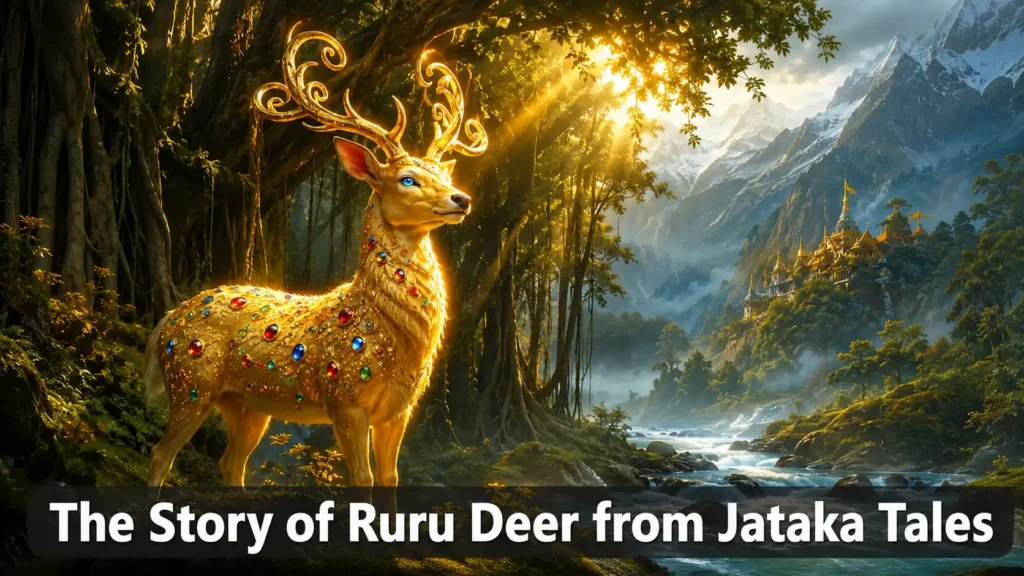
Introduction: The Golden Deer of the Himalayas
The Story of Ruru Deer from Jataka Tales is the first in the Pali collection and a cornerstone of Buddhist literature. The Story of Ruru Deer from Jataka Tales recounts a tale of betrayal, forgiveness, and human ingratitude that was carved into the ancient stupas of Bharhut and Sanchi. Pilgrims revered the golden deer as a symbol of the Bodhisatta’s boundless metta (loving-kindness). Today, The Story of Ruru Deer from Jataka Tales remains one of the most beloved narratives in Buddhist tradition.
Unlike remote deities, The Story of Ruru Deer from Jataka Tales shows the Bodhisatta appearing here as a vulnerable creature—a deer who risks everything to save a stranger, only to be betrayed. Yet he does not seek revenge. He forgives, teaching that true virtue is not conditional upon others’ gratitude. In his quiet dignity, The Story of Ruru Deer from Jataka Tales offers an antidote to our own tendencies toward resentment.
Table of Contents
The Story of Ruru Deer from Jataka Tales
The Enchanted Forest
In the misty Himalayas, where jasmine-scented breezes whispered through ancient trees, lived a deer unlike any other. Named Ruru—”the one who shines like a jewel”—his body blazed with molten gold, adorned with spots of ruby, sapphire, and emerald. His hooves gleamed like crystal; his spiraling horns rivaled polished ivory. But his most remarkable feature was his sky-blue eyes, holding the wisdom of countless past births.
Ruru possessed full memory of his previous existences and could speak the human tongue. Yet this wisdom brought wariness—he knew the greed and cruelty of men. He kept to the deepest thickets, avoiding human paths. Despite his isolation, his heart overflowed with compassion. He nursed injured birds, guided lost fawns, and shared the sweetest grazing spots with the elderly and weak. He was a bodhisattva in deer form, practicing loving-kindness in secret.
The forest creatures adored him. The monkeys would chatter joyfully when he passed, the elephants would lower their trunks in greeting, and the birds would sing sweeter songs in his presence. Ruru embodied the ideal of harmlessness, never stepping on an ant or disturbing a nest. His life was a continuous offering of peace to the world around him.
Yet despite this idyllic existence, Ruru remained watchful. He had seen the shadows of human civilization creeping closer to the forest’s edge. He had heard tales of hunters and kings who slaughtered without remorse. His wisdom told him that his golden form was both a blessing and a curse—beautiful enough to inspire wonder, but valuable enough to inspire greed.
Little did he know that The Story of Ruru Deer from Jataka Tales would soon unfold in ways he could never imagine.
A Cry in the Wilderness
One afternoon, near the turbulent Ganges, a desperate cry pierced the forest’s peace. Ruru bounded toward the sound and found a merchant being battered by raging rapids. The man’s strength was failing; each time his head sank beneath the foam, Ruru feared it would be his last.
Forgetting his fear of men, Ruru plunged into the icy current. “Hold fast! I am coming!” he cried. Reaching the drowning man, he commanded, “Cling to my back!” But panic robbed the man of reason—he scrambled onto Ruru’s delicate spine, crushing him with his full weight. Gasping under the burden, Ruru pushed forward stroke by agonizing stroke until his hooves scraped the riverbank. He collapsed beside the man, exhausted and bruised.
The river had been merciless that day. The monsoon rains had swollen the Ganges into a churning monster of white foam and deadly currents. Ruru’s legs ached from the relentless struggle. His golden coat, usually radiant, was matted and dull with exhaustion. Yet he had succeeded. The man was alive.
For a long moment, neither moved. Ruru’s chest heaved with labored breaths. The man lay limp, his face pale, his lips blue. But slowly, color returned to his cheeks. His eyelids fluttered open, and he stared at the magnificent creature crouched beside him—the very being who had dragged him from death’s embrace.
This incredible moment would become a turning point in The Story of Ruru Deer from Jataka Tales.
The Oath of Silence
When the man revived, he wept with gratitude. “No friend from childhood has ever done what you have done. My life is yours. Command me!”
Ruru looked into the man’s soul, seeing both sincerity and the shadow of greed. “Promise me you will tell no one of my existence. Men are fickle—they will covet my golden hide and jeweled horns. Guard my secret.”
The man swore a sacred oath: “By the sun and earth, I will never betray you!” Ruru helped him to his feet and sent him on his way. But as the man’s footsteps faded, the wise deer heard an ominous echo—the sound of a promise destined to be broken.
The man walked through the forest, his heart torn between gratitude and the creeping tendrils of greed. He was a merchant by trade, accustomed to calculating profit and loss. And now, as he looked back toward the river, his mind began to calculate the value of the creature he had just met. How much would a king pay for such a magnificent beast? How many bags of gold, how many estates, how many beautiful women?
He shook his head violently, trying to banish the thoughts. “No, I swore an oath. I will keep my word.” But the seed of greed had been planted, and it would grow in the darkness of his heart.
Meanwhile, Ruru returned to his forest home. He grazed peacefully, but his heart was heavy. He had seen the flicker of avarice in the man’s eyes, and he knew that human nature was weak. He could only hope that the man’s gratitude would overcome his greed.
This was the tragedy that The Story of Ruru Deer from Jataka Tales would ultimately reveal.
The Queen’s Dream
Far away, King Brahmadatta ruled a prosperous kingdom. His queen, restless and longing for something extraordinary, had a vivid dream. She stood in a crystalline forest where a golden deer with jeweled spots sat upon a lotus throne, expounding the Dhamma in articulate human speech.
She woke in tears. “My king, you must find this golden deer! I will never know peace until I see him!” The king, adoring his queen, dispatched criers throughout the land: “A hundred villages and ten beautiful concubines to any man who leads the royal hunt to the Golden Ruru Deer!”
The queen’s dream had been unusually vivid. She could still hear the deer’s voice, still see the shimmer of his golden hide, still feel the warmth of compassion radiating from his eyes. She had never been a particularly spiritual woman, but something about this dream had awakened a longing in her soul. She needed to see this creature. She needed to understand the source of his wisdom.
But the king, despite his love for her, harbored a different ambition. He saw the deer not as a teacher but as a prize. To capture such a magnificent creature would immortalize his reign. Historians would write of him, poets would sing of his triumph. The deer would become a living treasure, a symbol of his power and glory. The queen’s spiritual longing and the king’s political ambition had converged—and both would lead to the same fateful hunt.
The proclamation spread like wildfire. Villagers whispered about the golden deer. Merchants speculated about the reward. But deep in the forest, Ruru heard nothing—the wind did not carry such news to his secluded grove.
The Betrayal
When the proclamation reached the man Ruru had saved, he recoiled in horror. “I made a sacred oath! I will not betray my savior!”
But greed gnawed at him. He was a poor trader. The image of the golden deer transformed in his mind—no longer a rescuer but a pile of gold, an estate, beautiful women. “Why remain poor while that creature roams the forest? He is just an animal! My happiness is worth more than an oath to a beast!”
His conscience screamed, but greed was louder. That evening, he threw himself at the king’s feet. “Great King, I know where the Golden Deer dwells! I alone can lead you to him!”
But as he raised his hand to point toward the forest, his hand—without pain, without blood—fell from his wrist and clattered on the marble floor. The court gasped. Yet even in his agony, the man’s greed remained. “It is a trick of the deer! He is a demon! Follow me!” The king, swayed by the promise of capturing the divine creature, commanded: “Ready the royal hunt!”
The man’s severed hand lay on the floor like a grim omen. But the king, blinded by his ambition, chose to ignore the warning. He ordered the court physicians to tend to the traitor’s wound and commanded his generals to prepare an army of hunters. Elephants were adorned with battle armor, archers sharpened their arrows, and the royal procession set out at dawn.
The forest trembled at their approach. Birds fled from the trees. Deer scattered in panic. The traitor, his stump wrapped in bloody linen, limped at the head of the army, following the half-forgotten path to Ruru’s hiding place. His face was pale not only from pain but from the weight of his betrayal. Yet he did not turn back.
The Hunt in the Thicket
The royal procession crashed through the forest—elephants, archers, and the traitor with his blood-soaked stump. In a sun-dappled clearing, surrounded by a hundred arrows, stood Ruru.
He did not flinch. He knew this was his karmic moment. His sky-blue eyes met the traitor’s, filled not with anger but with bottomless pity.
The king froze. The deer’s golden coat shimmered like a second sun; his jeweled spots pulsed with ethereal light. Even the strongest archer lowered his bow in awe.
“Is this a god or a beast?” the king whispered.
Ruru stepped forward with supreme dignity. “Great King, before you release your arrow, satisfy my curiosity. How did you find this secret place? No hunter has ever tracked me here.”
The king pointed his arrow toward the traitor. “This man led us here. He claims to have met you before.”
Ruru’s voice was thick with sorrow as he recited the ancient verse:
"Better to lift a heavy log from swirling waters
Than to save an ungrateful wretch from drowning—
For the log will not betray you;
It will not sell your precious life for silver and greed."
The words hung in the air like a lament. The archers exchanged uneasy glances. The king’s grip on his bow loosened. Something was wrong here—very wrong. This deer spoke like a sage, thought like a king, and looked upon his betrayer with the eyes of a mother gazing at a wayward child. What kind of creature was this?
This was the question at the heart of The Story of Ruru Deer from Jataka Tales.
The Truth Revealed
Ruru told the king everything—the desperate cry, the plunge into icy waters, the crushing weight, the sacred oath, and now the betrayal. “This man, whose life I cradled in my hooves, has come to sell my hide for your queen’s pleasure. Such is the nature of greed.”
The king’s face flushed with fury. “Wretch! You deserve a thousand deaths!” He aimed his bow at the traitor’s heart. The man fell to his knees, weeping for mercy—the same mercy he had denied his benefactor.
But Ruru stepped between the arrow and the doomed man. “Spare him, great king. He is a fool enslaved by desire. He has lost his hand, his honor, and his peace. Let him live. Perhaps one day he will learn gratitude.”
“You would plead for the man who sold you to death?” the king asked, stunned.
Ruru replied softly, “A bodhisattva does not love only those who love in return. True compassion flows freely. I saved him once because he suffered. I save him again because I do not suffer. My heart cannot be sullied by ingratitude.”
The king lowered his bow. Tears streamed down his face. He knelt before the deer. “You have shamed me with your virtue. I came to capture you—instead, you have captured my heart.”
The traitor was beaten and cast out of the kingdom. But his life was spared—a final gift from the very being he had tried to destroy.
The Royal Guest
“Golden Ruru,” the king implored, “please visit my capital as my honored guest. Let my people learn from your wisdom.” Ruru agreed, seeing a chance to plant seeds of virtue.
The journey was unlike any royal parade. The king’s own golden chariot carried the deer through cheering crowds. Citizens wept with joy, showering him with garlands. In the royal court, Ruru ascended the throne and discoursed for three days on the Four Noble Truths, the futility of greed, and the power of loving-kindness. The queen’s initial infatuation with his beauty transformed into reverence for his wisdom.
The people of Benares had never seen anything like it. A deer—a golden deer, no less—sitting upon the throne of their king, speaking in perfect human language, expounding the deepest truths of existence. Philosophers came to debate him and left as his students. Warriors came to mock him and left in tears. The queen, who had once dreamed of possessing him, now bowed at his feet.
When his teachings ended, Ruru declared, “My time here is done. Remember my words. Let kindness be your law, and gratitude your daily offering.” Before the king could protest, Ruru bounded through the palace gates, through the city, and vanished into the wilderness, never to be seen by human eyes again.
The cry of jackals and birds is understood with ease; but the word of men is far harder to decipher—for it changes with every gust of selfish desire.
Moral of the Story: The Perfection of Gratitude and the Poison of Ingratitude
The Ruru Jataka is a profound mirror held to the human psyche, illuminating two opposing forces: gratitude (kataññutā) and its poison, ingratitude born of greed. The Story of Ruru Deer from Jataka Tales is a profound mirror held to the human psyche, illuminating two opposing forces: gratitude (kataññutā) and its poison, ingratitude born of greed.
In Buddhist psychology, gratitude is the foundation of spiritual progress. The Buddha taught that without gratitude, no wholesome quality can develop. Gratitude is the recognition of interconnectedness—we acknowledge that our existence is woven with the kindness of countless others. This dissolves the illusion of a separate ego. The Bodhisatta understood this perfectly; his heart swelled with compassion because he recognized the interdependent web of life.
The traitor represents the unenlightened mind. His gratitude was fleeting—a mere emotional spasm. As soon as danger passed, his cravings reasserted themselves. He did not reflect on the deeper meaning of Ruru’s sacrifice. He reduced the sacred to the transactional: the deer’s body became a commodity, his oath an inconvenience, his conscience a nuisance.
The queen’s dream critiques the fetishization of spiritual beauty. She was enchanted not by wisdom but by luminous appearance—a warning for those who chase religious teachers or rituals without genuine transformation. She learned authenticity when she witnessed Ruru’s teachings.
Ruru’s plea for the traitor’s life reveals the heart of the Bodhisattva ideal. Bodhisattva means “enlightenment-being”—one dedicated to awakening all beings without exception. His forgiveness is unconditional, breaking the karmic chain that would otherwise ensnare both in future lifetimes of enmity.
The haunting final line—“The cry of jackals and birds is understood with ease; the word of men is far harder”—reminds us that animals communicate honestly, while human speech is layered with deception. We say “I love you” when we mean “I need you.” We swear “I’ll never betray you” while already calculating the sale. In our world of spin and manipulation, the Ruru Jataka invites us to become discerning listeners—and above all, to purify our own speech.
Ruru gave freely, expecting nothing. When his gift was trampled, he did not withdraw his kindness. This is the supreme test of generosity: can we give without clinging to the outcome? The Bodhisattva’s answer is yes. The act of showing compassion purifies the giver’s mind regardless of the receiver’s response.
When tempted to withhold forgiveness, recall the golden deer pleading for his betrayer. When tempted by cruelty, remember the king’s tears of shame. And when weaving honeyed words while harboring selfish motives, hear Ruru’s warning: the jackal’s howl is honest; the bird’s call is pure; but the word of man is the trickiest puzzle of all. May we all strive to be like Ruru—radiant with virtue, unwavering in compassion, and free from resentment.
In our world of spin and manipulation, The Story of Ruru Deer from Jataka Tales invites us to become discerning listeners—and above all, to purify our own speech. By exploring The Story of Ruru Deer from Jataka Tales, we gain timeless wisdom that continues to guide spiritual seekers on the path to enlightenment.

Get the ThePoemStory App — Read Poems Anywhere