The Story of The Two Deer from Jataka Tales: The Wise and the Rash – A Tale of Caution and Foresight
A timeless tale of wisdom and caution from the Buddha Jataka Tales, exploring the depths of Jataka Stories Buddhism, the profound lessons of the Buddha Life Story, and the transformative power of ancient Buddhist Stories.
Introduction: The Wise and the Rash
The Story of The Two Deer from Jataka Tales is a powerful teaching on the importance of wisdom, caution, and heedfulness. It recounts the tale of an old deer king who entrusted his two sons with the leadership of separate herds. The Story of The Two Deer from Jataka Tales contrasts the outcomes of wise, careful planning versus rash, reckless action.
This Jataka illustrates the Buddhist teaching on heedfulness—the quality of being mindful, cautious, and aware of consequences. The Story of The Two Deer from Jataka Tales shows that wisdom is not merely intelligence but the ability to foresee dangers and act accordingly. The Story of The Two Deer from Jataka Tales teaches that rashness leads to destruction while careful planning leads to safety.
As we journey through The Story of The Two Deer from Jataka Tales, we discover that true wisdom lies in heeding good counsel. The Story of The Two Deer from Jataka Tales reminds us that the wise listen to those who have walked the path before them.
Table of Contents
The Story of The Two Deer from Jataka Tales
The Wise Father
In a forest close to the Magadha janapada, there lived a wise old deer who was the leader of a large band of one thousand deer. He was respected and revered by all the animals of the forest. His wisdom had guided his herd through countless dangers, and his compassion had protected them from harm. The Story of The Two Deer from Jataka Tales centres on this noble leader and his two sons.
The old deer had two young sons: Lakkhana and Kala. Lakkhana was wise, patient, and thoughtful—a young deer who listened carefully to his father’s counsel and reflected deeply before acting. Kala was rash, haughty, and impulsive—a young deer who trusted his own instincts above the wisdom of others. Despite their different natures, the old deer loved both his sons equally.
As the old deer grew older, he began to feel the weight of his years. His limbs were not as strong as they once were. His eyes were not as sharp. He knew that the time would soon come when he would no longer be able to lead his herd. He needed to prepare his sons to take on the responsibility of leadership. The Story of The Two Deer from Jataka Tales would reveal which son was truly worthy of leading the herd.
The old deer made a decision. “I will divide the herd,” he said. “Each of my sons will lead five hundred deer. This will give them the opportunity to learn the skills of leadership and to prove their wisdom.” The Story of The Two Deer from Jataka Tales teaches that wise leaders prepare their successors.
The Harvest Season
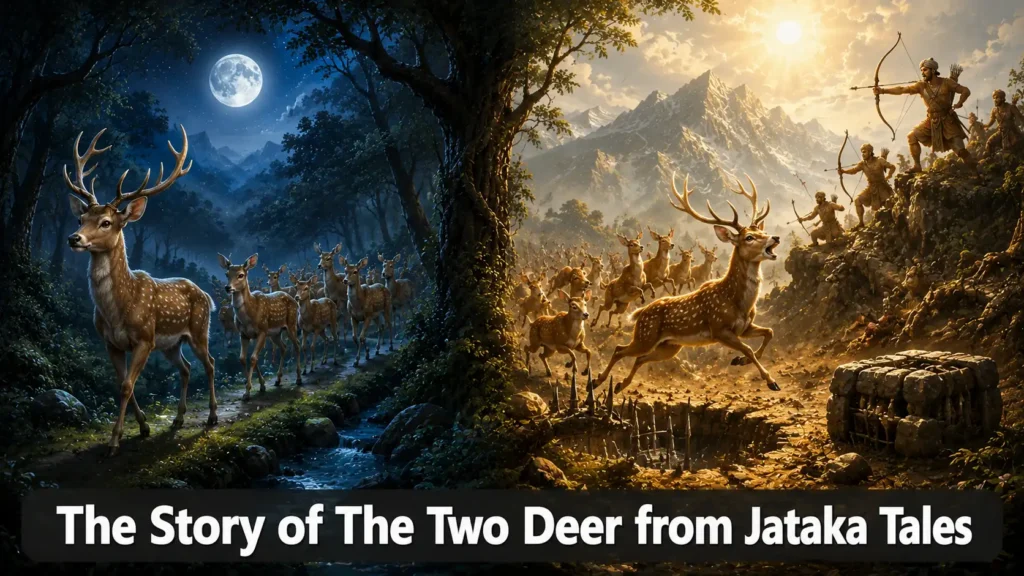
As time passed, the harvest season approached. The farmers of the land were taking every precaution to protect their crops from the animals. They dug pitfalls along the forest edges. They fixed sharp stakes in the ground. They set stone traps that would crush any creature foolish enough to approach.
The farmers also positioned hunters throughout the fields. The hunters waited with their bows, ready to shoot any animal that came near the ripening crops. The Story of The Two Deer from Jataka Tales reveals the dangers of the harvest season and the importance of foresight.
The old deer, with his years of experience, knew the dangers intimately. He had led his herd through countless harvest seasons. He knew the patterns of the farmers, the location of the traps, and the safest routes to safety. He knew that the harvest season was the most dangerous time of the year for his people.
The old deer called his two sons to him. “My sons,” he said, “the harvest season is upon us. The farmers are setting traps and the hunters are ready with their arrows. This is a time of great danger. You must lead your herds to safety.”
This was the moment that would define The Story of The Two Deer from Jataka Tales—the moment when each son’s true nature would be revealed.
The Father’s Warning
The old deer looked at his sons with love and concern. “Listen carefully to my words,” he said. “I have led this herd through many seasons, and I know the dangers you will face. The farmers are not the only threat—there are also predators who take advantage of the chaos of the harvest. You must be wise and cautious.”
He turned to Lakkhana first. “My wise son, I know you will listen to my counsel. Take your five hundred deer and travel only by night. The darkness will conceal you from the hunters. Move slowly and carefully. Avoid the main paths—they are filled with traps. Take the hidden routes through the forest. The journey will take longer, but you will arrive safely.”
Then he turned to Kala. “My son, I also speak to you. Do not be rash. Do not rush blindly toward the mountains. The hunters are watching for any movement. They will ambush you if they see you. Take your time. Travel at night. Avoid the traps. Listen to the warnings of those who have gone before you.”
Lakkhana listened carefully and nodded. “I will follow your advice, Father. I will be cautious. I will travel at night. I will protect my herd.”
But Kala was impatient. He did not see the need for caution. He was young, strong, and confident. He had led his herd before, and he had always succeeded. The Story of The Two Deer from Jataka Tales reveals the arrogance of youth that refuses to learn from experience.
“I do not need to travel at night,” Kala declared. “I am a strong leader. My herd will follow me safely. The hunters are not as clever as you think, Father. I will reach the mountains quickly and show you that I am right.”
This was the question at the heart of The Story of The Two Deer from Jataka Tales—would Kala’s arrogance lead him to disaster?
The old deer could only sigh. He loved his son, but he could not force him to listen. “Go then, my son. I hope you find safety. May your journey be blessed.”
But in his heart, he knew the dangers that awaited the rash young deer. The Story of The Two Deer from Jataka Tales was about to reveal the consequences of heedlessness.
The Rash Son
Kala, without paying much heed to his father’s wise advice, rushed to the mountains with his herd. His heart was filled with pride and a sense of invincibility. He did not bother to remember that the people were quite likely to ambush, shoot, and kill them before they could finally reach the mountain.
He led his herd during the day, his pace swift and reckless. He took the most direct route, unaware that the hunters were watching. The farmers had seen the deer moving through the forest. They had prepared their traps accordingly.
The hunters attacked without mercy. They shot volleys of arrows into the herd. The deer scattered in panic. Some fell, their lives ended by the hunters’ weapons. Others stumbled into hidden pitfalls and were trapped. Many were crushed by stone traps set by the farmers. The Story of The Two Deer from Jataka Tales shows the tragic consequences of ignoring wise counsel.
Kala watched in horror as his followers fell around him. He had been so confident, so sure of his ability to lead. But his arrogance had led to disaster. He had rushed forward without thought, and now his followers were paying the price.
By the time Kala and his remaining followers finally reached the mountain, most of his herd was gone. He arrived weary, wounded, and ashamed. The herd he had led was a fraction of its former size. The pride he had felt was replaced by grief and regret.
Kala had learned a painful lesson. The Story of The Two Deer from Jataka Tales teaches that rashness leads to destruction while wisdom leads to safety. The Story of The Two Deer from Jataka Tales reveals the consequences of heedlessness.
The Wise Son
Lakkhana, however, took the advice of his father seriously. He was wise and cautious, a leader who knew the value of listening to those with experience. He gathered his five hundred deer and began the journey to the mountains.
He traveled only at night. The darkness concealed his movements from the hunters. He moved slowly and carefully, avoiding the main paths that were filled with traps. His herd followed him without question, trusting their wise leader to guide them to safety. The Story of The Two Deer from Jataka Tales shows the power of patient, careful planning.
When they encountered obstacles, Lakkhana did not rush. He assessed the situation calmly, finding the safest path forward. When they heard the sounds of hunters in the distance, he led his herd to safety, taking detours that avoided detection.
The journey took longer than Kala’s reckless dash, but Lakkhana did not mind. He knew that the safety of his herd was more important than speed. He was patient and deliberate, a leader who thought carefully before acting.
Finally, after many nights of careful travel, Lakkhana reached the mountain with all his companions safe and unharmed. His herd was intact, his followers grateful, and his father proud.
This was the triumph that The Story of The Two Deer from Jataka Tales celebrates—the victory of wisdom over recklessness. The Story of The Two Deer from Jataka Tales shows that careful planning and patience lead to success.
The contrast between the two brothers could not have been starker. Kala had lost most of his followers. Lakkhana had saved all of his. The two brothers had started with equal numbers, but their choices had led to vastly different outcomes. The Story of The Two Deer from Jataka Tales reveals the importance of listening to wise counsel.
The Reunion
After four long months, the harvest season ended. The crops had been gathered, the hunters had returned to their villages, and the traps had been dismantled. It was safe for the deer to return to their forest home.
Both brothers led their herds back to the forest to reunite with their father. The old deer waited anxiously, hoping that both his sons had survived. When he saw Lakkhana approaching with his full herd of five hundred deer, his heart swelled with pride. But when he saw Kala approaching with his small, depleted herd, his heart sank with sorrow.
The old deer looked at the two herds. Most of Kala’s followers were missing—hundreds of deer had perished because of his recklessness. But all of Lakkhana’s followers had arrived safely. The contrast was heartbreaking.
When the old deer heard the whole story, he praised the wisdom of Lakkhana and congratulated him. “My wise son, you have shown the qualities of a true leader. You listened to my advice. You were patient and cautious. You protected those entrusted to your care. I am proud of you.”
Then he turned to Kala, and his voice was heavy with disappointment. “My son, you have much to learn. Your arrogance led to the death of many of your followers. A leader who does not listen to wise counsel is a leader who will fail. I hope you have learned the value of humility and caution.”
Kala bowed his head, his heart filled with shame. He had learned his lesson, but the cost had been great. The Story of The Two Deer from Jataka Tales teaches that wisdom is not inherited—it is earned through listening and learning. The Story of The Two Deer from Jataka Tales reveals the importance of heeding good counsel.
Thus, The Story of The Two Deer from Jataka Tales concluded with a powerful lesson: the wise thrive while the rash suffer. The Story of The Two Deer from Jataka Tales reminds us that the counsel of the wise is a gift to be cherished, not a burden to be ignored. The Story of The Two Deer from Jataka Tales teaches us to listen, to learn, and to lead with humility.
Moral of the Story: The Perfection of Wisdom and Heedfulness
The Story of The Two Deer from Jataka Tales is a profound teaching on the perfection of wisdom (panna paramita) and the quality of heedfulness (appamada). It illustrates the importance of listening to wise counsel, planning carefully, and avoiding the dangers of rashness and arrogance.
In Buddhist philosophy, heedfulness is considered the foundation of all spiritual progress. The Buddha himself emphasized the importance of heedfulness in his final teaching: “Heedfulness is the path to the deathless. Heedlessness is the path to death.” The Story of The Two Deer from Jataka Tales illustrates this teaching perfectly. Lakkhana’s heedfulness led to safety and success. Kala’s heedlessness led to destruction and loss.
The old deer represents the importance of experience and wise counsel. The Story of The Two Deer from Jataka Tales teaches that those who have walked the path before us have wisdom to share. The wise listen to their elders, learning from their experiences rather than repeating their mistakes.
Lakkhana embodies the virtue of patience. He did not rush. He did not take shortcuts. The Story of The Two Deer from Jataka Tales reveals that patience is not weakness—it is wisdom. True leaders understand that speed is not always the best path. Sometimes, the slow and steady route is the one that leads to success.
Kala’s story is a warning. His arrogance blinded him to the dangers around him. He thought he knew better than his father, and his hubris led to the deaths of many. The Story of The Two Deer from Jataka Tales reminds us that pride goes before a fall. A leader who does not listen is a leader who will fail.
This Jataka also teaches the importance of foresight. The old deer anticipated the dangers of the harvest season. The Story of The Two Deer from Jataka Tales reminds us that wise leaders think ahead. They plan for potential problems and take steps to mitigate them before they arise.
In our own lives, The Story of The Two Deer from Jataka Tales invites us to examine our own approach to decision-making. Do we rush into things without thinking? Do we listen to wise counsel, or do we ignore the advice of those who have more experience? The Story of The Two Deer from Jataka Tales teaches that wisdom comes from listening, learning, and planning.
The contrast between Lakkhana and Kala is also a reminder that our choices have consequences. Every decision we make affects not only ourselves but also those who depend on us. The Story of The Two Deer from Jataka Tales teaches us that leaders have a responsibility to those they lead. We must be wise, cautious, and humble in our leadership.
By exploring The Story of The Two Deer from Jataka Tales, we gain timeless wisdom about the importance of heedfulness and the value of wise counsel. The Story of The Two Deer from Jataka Tales guides us toward a path of careful, thoughtful, and compassionate leadership.
In our world of haste and arrogance, The Story of The Two Deer from Jataka Tales invites us to examine our approach to decision-making. By exploring The Story of The Two Deer from Jataka Tales, we gain timeless wisdom about the power of caution and the importance of listening to wise counsel.
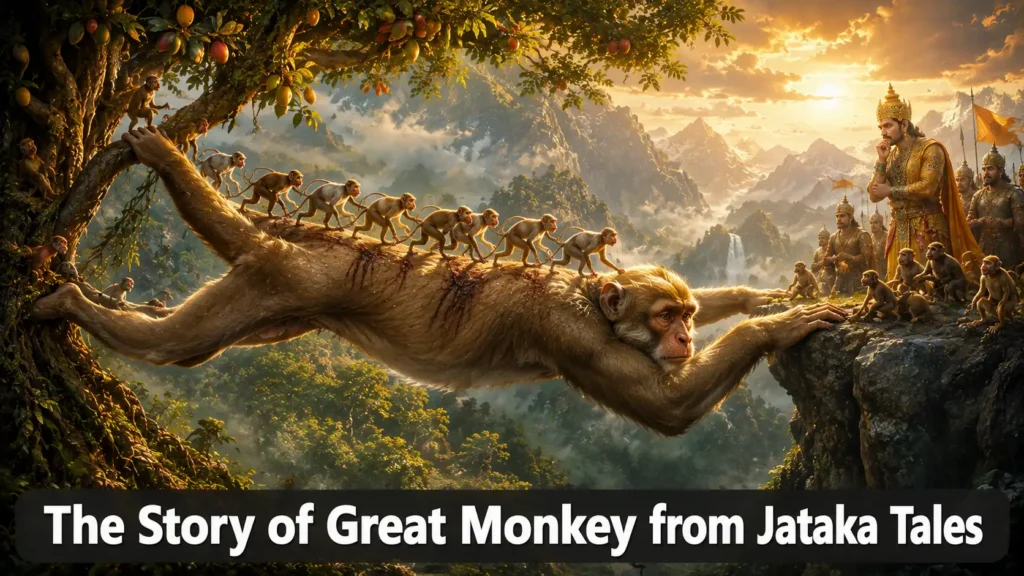
Read the previous story: The Story of Great Monkey from Jataka Tales – The Selfless King Who Became a Bridge for His Subjects

Get the ThePoemStory App — Read Poems Anywhere