The Story of a Buffalo from Jataka Tales: The Gentle Giant Who Practiced Forbearance
A timeless tale of patience and forbearance from the Buddha Jataka Tales, exploring the depths of Jataka Stories Buddhism, the profound lessons of the Buddha Life Story, and the transformative power of ancient Buddhist Stories.
Introduction: The Gentle Buffalo
The Story of a Buffalo from Jataka Tales is a powerful teaching on the virtue of patience, forbearance, and non-retaliation. It recounts the Bodhisatta’s birth as a gentle buffalo who endured relentless abuse from a wicked monkey without ever striking back. The Story of a Buffalo from Jataka Tales illustrates the perfection of patience (khanti paramita) at its highest level.
This Jataka is unique in its depiction of a being who refuses to retaliate despite having the power to do so. The Story of a Buffalo from Jataka Tales shows that true strength lies not in the ability to harm but in the ability to endure. The Story of a Buffalo from Jataka Tales teaches that forbearance is not weakness—it is the highest form of virtue.
As we journey through The Story of a Buffalo from Jataka Tales, we discover that karmic justice operates according to its own laws. The Story of a Buffalo from Jataka Tales reminds us that we do not need to punish those who wrong us—the universe has its own way of balancing accounts.
Table of Contents
The Story of a Buffalo from Jataka Tales
The Gentle Giant
In the lush forests of Himava, there lived a buffalo who was the Bodhisatta in one of his previous births. The Story of a Buffalo from Jataka Tales centres on this gentle being whose heart was filled with righteousness and compassion. His body was dark and heavy, his appearance rough and dirty-looking. To the casual observer, he appeared to be just another ordinary buffalo—ugly and unremarkable.
But appearances can be deceiving. Beneath his rough exterior lay a heart of pure virtue. The buffalo believed in righteousness with every fibre of his being. He exerted his best efforts to uphold the value of good conduct. He was gentle, patient, and kind—a being who embodied the ideal of harmlessness (ahimsa) in all his actions.
Despite being born in the animal state, the buffalo possessed extraordinary wisdom. He understood the law of karma—that actions have consequences, and that harming others ultimately harms oneself. The Story of a Buffalo from Jataka Tales reveals that true wisdom is not limited by birth or species. A being who practices virtue, regardless of their form, is worthy of respect.
The buffalo lived peacefully in the forest, grazing on the grass, drinking from the streams, and living in harmony with all creatures. The Story of a Buffalo from Jataka Tales would soon test his virtue in ways he could never have imagined.
The Wicked Monkey
In the same forest, there lived a wicked monkey. This monkey was cruel, arrogant, and malicious. He took great pleasure in tormenting other creatures, especially those who were gentle and patient. The monkey had no respect for the peace of others—he derived his joy from causing pain and distress.
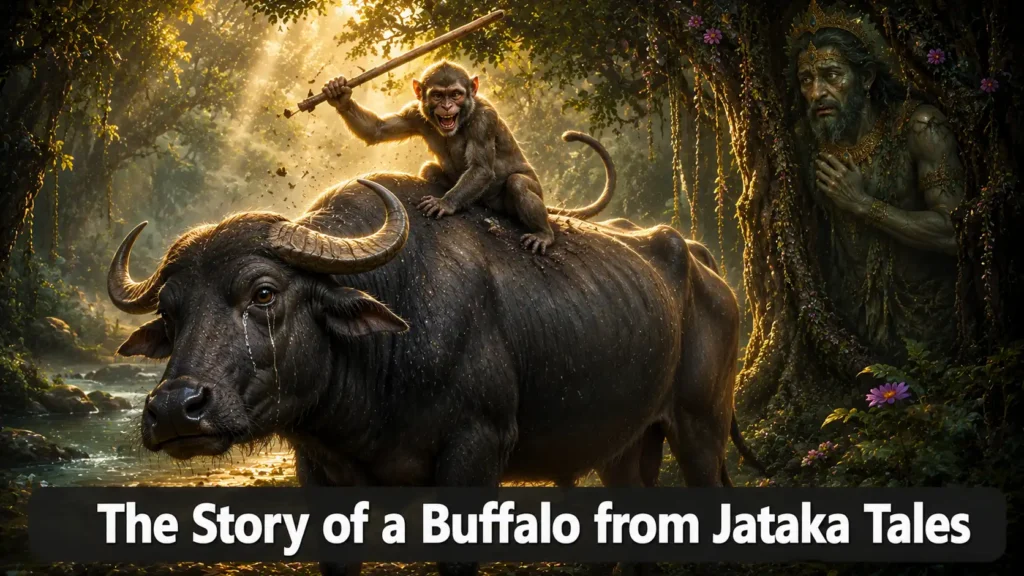
One day, the monkey noticed the gentle buffalo and recognized him as an easy target. The buffalo’s patient nature made him the perfect victim for the monkey’s cruel games. The monkey began to tease and bully the buffalo relentlessly. He would leap upon the back of the sleeping buffalo, startling him from his rest. He would obstruct him from grazing the grass, preventing him from feeding. The Story of a Buffalo from Jataka Tales reveals the depths of the monkey’s cruelty.
Sometimes, the monkey would climb on the buffalo’s head, holding his horns for support. Then he would swing down by holding his tail, treating the gentle giant like a playground. Sometimes he would mount on the buffalo’s back with a brandishing stick, pretending to be Yamaraja—the lord of death himself. In Indian mythology, the buffalo is said to be the vehicle of Yamaraja, and the monkey thought this made his mockery even more amusing. The Story of a Buffalo from Jataka Tales shows the arrogance of those who mistake patience for weakness.
The monkey’s antics were relentless. Day after day, he tormented the gentle buffalo. The buffalo endured all of it without complaint. He never raised his horns in anger. He never shook the monkey off. He bore all of the monkey’s unbecoming behaviour with patience and dignity. The Story of a Buffalo from Jataka Tales teaches us that true strength lies in endurance.
This was the question at the heart of The Story of a Buffalo from Jataka Tales—how long could the buffalo’s patience endure?
The Test of Patience
The buffalo’s patience was not weakness—it was a deliberate practice of virtue. He knew that he could easily crush the monkey. His strength was immense, his power undeniable. With one swift movement, he could throw the monkey off his back and trample him into the ground. But he chose not to. He chose to practice forbearance.
The Story of a Buffalo from Jataka Tales reveals that true virtue is tested in the face of provocation. Anyone can be kind to those who are kind to them. But to be kind to those who hurt us—that is the mark of a truly virtuous being. The buffalo understood this deeply. He was committed to the practice of patience, and he would not let the monkey’s cruelty shake his resolve.
Each day, the monkey’s torments continued. Each day, the buffalo endured them without complaint. He did not seek revenge. He did not harbor resentment. He simply bore the abuse with equanimity, knowing that his virtue was being perfected with each test. The Story of a Buffalo from Jataka Tales shows us that patience is not passive—it is an active practice of self-control.
But there were others in the forest who could not bear to watch the monkey’s cruelty. One such being was a yaksa—a spirit of a tree who had witnessed the monkey’s mistreatment of the gentle buffalo. The yaksa was filled with righteous indignation. He could not understand why the buffalo did not defend himself. The Story of a Buffalo from Jataka Tales was about to reveal the power of patience over retaliation.
This was the moment that would deepen The Story of a Buffalo from Jataka Tales—the moment when the buffalo’s virtue would be tested by the temptation to retaliate.
The Yaksa’s Temptation
The yaksa could not contain his anger any longer. He appeared before the buffalo and spoke with great urgency. “O gentle buffalo, why do you tolerate such abuse? You are so much stronger than that wicked monkey. You could easily crush him with one blow. Why do you let him torment you day after day?”
The buffalo looked at the yaksa with patient eyes. He understood the yaksa’s frustration, but he also understood the deeper principles of virtue. He responded calmly, “My friend, I appreciate your concern. But I must ask you—why should I inflict grief on others to overcome my own discomfort? Is that truly virtue?”
The yaksa was taken aback by the buffalo’s words. He had expected anger, frustration, or at least a desire for justice. Instead, he found wisdom and compassion. The Story of a Buffalo from Jataka Tales shows that true virtue is not reactive—it is thoughtful and principled.
The buffalo continued, “Inflicting grief on others to overcome one’s own discomfort is no virtue. The result of such acts shall not bear the fruits of true happiness. If I harm the monkey, I will only create suffering for myself. The karmic consequences of harming another being are inevitable. I would rather endure temporary discomfort than create the seeds of future suffering.”
The yaksa was deeply moved by the buffalo’s wisdom. He had never encountered such patience and insight in any being. “But surely,” the yaksa persisted, “the monkey deserves to be punished. He is cruel and wicked. He has tormented you for so long.”
The buffalo replied gently, “My friend, the monkey will have his lesson. But I will not be the one to teach it. One day, the monkey’s own actions will bring about his punishment. I will be saved from the guilt of inflicting pain on another being. That is the path of righteousness.”
The Story of a Buffalo from Jataka Tales teaches us that karmic justice operates according to its own laws. We do not need to be the instruments of punishment. The universe has its own way of balancing accounts.
This was the wisdom at the heart of The Story of a Buffalo from Jataka Tales—the understanding that patience and forbearance are the highest virtues.
The Buffalo’s Wisdom
The buffalo’s response to the yaksa reveals the depth of his spiritual understanding. He was not simply enduring abuse out of weakness or fear. He was consciously practicing the perfection of patience. He understood that retaliation only perpetuates cycles of violence.
The Story of a Buffalo from Jataka Tales teaches us that true peace comes not from defeating our enemies but from overcoming our own anger. The buffalo had transcended the impulse to retaliate. His mind was free from resentment. He could see the monkey’s cruelty as the monkey’s own problem, not as something that diminished his own virtue.
The buffalo’s words to the yaksa are a profound teaching on karma. “Inflicting grief on others to overcome one’s own discomfort is no virtue.” This is a fundamental truth of the Buddhist path. The end does not justify the means. We cannot achieve peace through violent actions. We cannot create happiness through causing suffering. The Story of a Buffalo from Jataka Tales reminds us that our actions must be aligned with the principle of non-harming.
The buffalo also demonstrated incredible foresight. He knew that the monkey would eventually face the consequences of his actions. He did not need to be the instrument of punishment. He could trust in the law of karma. The Story of a Buffalo from Jataka Tales teaches us that we do not need to take justice into our own hands. The universe operates according to its own justice.
This was the question at the heart of The Story of a Buffalo from Jataka Tales—how could the buffalo be so confident that justice would prevail? The answer lies in his unwavering faith in the law of karma.
Karmic Justice
As the buffalo had predicted, the monkey’s own actions would soon bring about his downfall. A few days later, the gentle buffalo was away from his usual spot. In his place, a savage buffalo came and stood on the same ground. This buffalo was fierce, aggressive, and quick to anger—the complete opposite of the gentle Bodhisatta.
The wicked monkey, thinking that the savage buffalo was the same gentle one, approached him with his usual arrogance. He leaped onto the savage buffalo’s back and tried to play the same games. He jumped and swung and pretended to be Yamaraja, completely unaware of the danger he was in.
The savage buffalo was not patient. He was not forgiving. He did not practice forbearance. In no time, he shook the monkey off his back. The monkey hit the ground hard, and before he could scramble away, the savage buffalo pierced his horns straight into the monkey’s heart. He trampled him with his hooves, crushing the life out of him.
The monkey was killed in no time. His wickedness had finally caught up with him. The Story of a Buffalo from Jataka Tales reveals the inexorable nature of karma—our actions have consequences, and we will eventually reap what we sow.
The gentle buffalo, when he learned what had happened, felt no satisfaction. He felt only a deep compassion for the monkey who had died because of his own foolishness. The Story of a Buffalo from Jataka Tales teaches that a virtuous being does not rejoice in the suffering of others, even when they have been wronged.
The buffalo’s patience had been vindicated. He had not needed to harm the monkey. The monkey’s own actions had brought about his destruction. The Story of a Buffalo from Jataka Tales is a powerful lesson in the law of karma and the wisdom of patience.
Thus, The Story of a Buffalo from Jataka Tales concludes with a profound teaching: patience is not weakness—it is wisdom. The Story of a Buffalo from Jataka Tales reminds us that we do not need to retaliate against those who wrong us. The universe has its own way of balancing accounts. The Story of a Buffalo from Jataka Tales teaches us to trust in the law of karma and to practice forbearance in all circumstances.
Moral of the Story: The Perfection of Forbearance
The Story of a Buffalo from Jataka Tales is a profound teaching on the perfection of patience and forbearance (khanti paramita). It illustrates the power of non-retaliation and the wisdom of trusting in the law of karma. The buffalo’s patience was not a sign of weakness but a sign of extraordinary spiritual strength.
In Buddhist philosophy, patience is one of the most important virtues. The Buddha taught that anger and hatred are never justified. The Story of a Buffalo from Jataka Tales demonstrates that responding to cruelty with cruelty only perpetuates suffering. The buffalo’s refusal to retaliate broke the cycle of violence and preserved his own inner peace.
The monkey represents the dangers of arrogance and the karmic consequences of harmful actions. The Story of a Buffalo from Jataka Tales shows that wickedness ultimately leads to destruction. The monkey’s cruelty was his own undoing. He did not need the buffalo to punish him—his own actions created the conditions for his downfall.
The yaksa represents the human inclination toward justice and retaliation. The Story of a Buffalo from Jataka Tales teaches that our desire for revenge is not always wise. We must be patient and trust in the natural order of things. The yaksa’s temptation was a test of the buffalo’s commitment to virtue.
The buffalo’s words to the yaksa—”Inflicting grief on others to overcome one’s own discomfort is no virtue”—are a fundamental teaching of the Buddhist path. The Story of a Buffalo from Jataka Tales reminds us that our actions must be aligned with the principle of non-harming. We cannot achieve peace through violent means.
This Jataka also teaches the importance of faith in the law of karma. The buffalo trusted that justice would be served without his involvement. The Story of a Buffalo from Jataka Tales shows us that we do not need to be the instruments of punishment. The universe operates according to its own laws, and those who harm others will eventually face the consequences of their actions.
In our own lives, The Story of a Buffalo from Jataka Tales invites us to practice patience and forbearance. When others wrong us, we may feel the impulse to retaliate. The Story of a Buffalo from Jataka Tales calls us to a higher path—to endure with patience, to trust in karma, and to maintain our inner peace. The Story of a Buffalo from Jataka Tales teaches us that true strength lies not in our ability to harm others but in our ability to endure harm without losing our virtue.
By exploring The Story of a Buffalo from Jataka Tales, we gain timeless wisdom about the power of patience and the importance of trusting in the natural order of things. The Story of a Buffalo from Jataka Tales guides us toward a life of forbearance, compassion, and inner peace.
In our world of retaliation and vengeance, The Story of a Buffalo from Jataka Tales invites us to examine our capacity for patience. By exploring The Story of a Buffalo from Jataka Tales, we gain timeless wisdom about the power of forbearance and the wisdom of trusting in karma.
Read the previous story: The Story of The Two Deer from Jataka Tales – The Wise and the Rash – A Tale of Caution and Foresight

Get the ThePoemStory App — Read Poems Anywhere