The Story of Silava Elephant from Jataka Tales: The White Elephant Who Gave Until His Last Breath
A timeless tale of selfless giving and the danger of greed from the Buddha Jataka Tales, exploring the depths of Jataka Stories Buddhism, the profound lessons of the Buddha Life Story, and the transformative power of ancient Buddhist Stories.
Introduction: The White Elephant
The Story of Silava Elephant from Jataka Tales is a heartrending tale of selfless generosity and the devastating consequences of human greed. It recounts the Bodhisatta’s birth as Silava, a magnificent white elephant who embodied the perfection of giving (dana paramita) to its absolute limit. The Story of Silava Elephant from Jataka Tales shows that true generosity knows no bounds—even unto death.
This Jataka is a powerful warning about the nature of greed. The Story of Silava Elephant from Jataka Tales demonstrates that greed is never satisfied—it only grows stronger with each indulgence. The Story of Silava Elephant from Jataka Tales teaches that those who exploit the kindness of others will ultimately face the consequences of their actions.
As we journey through The Story of Silava Elephant from Jataka Tales, we discover that true virtue is tested in the face of ingratitude. The Story of Silava Elephant from Jataka Tales reminds us that the greatest gift we can offer is not our possessions but our compassion, even when it is not returned.
Table of Contents
The Story of Silava Elephant from Jataka Tales
The Radiant One
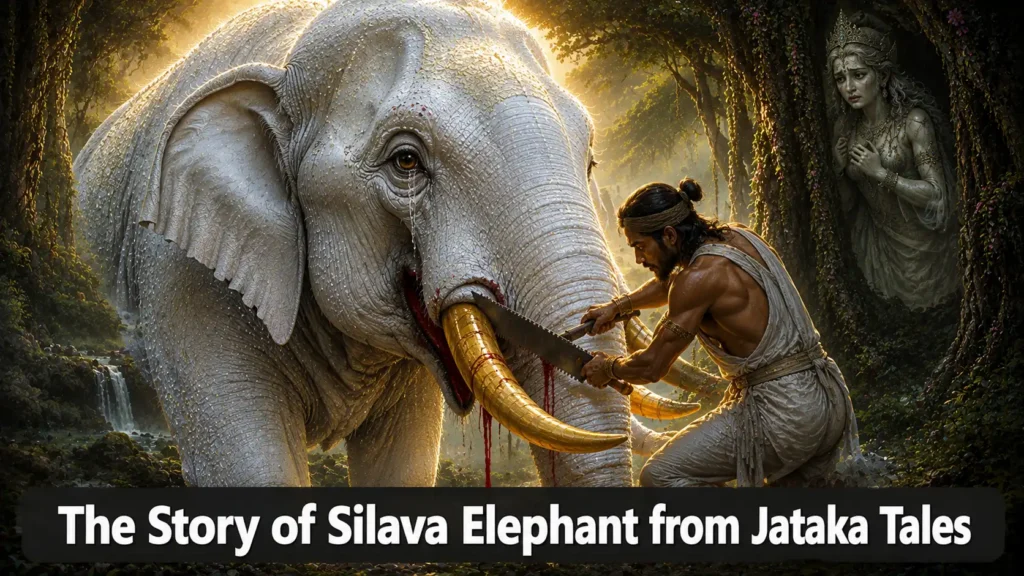
In the lush forests of the Himalayas, the Bodhisatta was born as an elephant of extraordinary beauty. The Story of Silava Elephant from Jataka Tales centres on this magnificent being whose appearance was unlike any other. He was white like silver, his body gleaming with a radiance that seemed to illuminate the forest around him. His eyes were like diamond balls, sparkling with wisdom and compassion. His mouth was red like the scarlet velvet, a striking contrast to his snowy white face.
His trunk was like silver flecked with red gold, a masterpiece of nature’s artistry. His four feet looked like polished lac, smooth and graceful. The Story of Silava Elephant from Jataka Tales describes his persona as possessing consummate beauty and ten-fold perfections—he was the embodiment of grace, strength, and virtue.
As he grew, Silava became the leader of eighty thousand elephants. His wisdom and compassion made him a beloved ruler, and his subjects revered him with deep respect. But despite his status as king of the elephants, Silava preferred a different path. He chose to lead the life of a recluse, living alone in a solitary forest. The Story of Silava Elephant from Jataka Tales reveals that true virtue seeks solitude for spiritual cultivation.
Silava’s heart was filled with compassion for all beings. He practiced the perfection of giving, ready to offer anything—even his own life—for the welfare of others. The Story of Silava Elephant from Jataka Tales would soon put his virtue to the ultimate test. This was the beginning of The Story of Silava Elephant from Jataka Tales.
The Lost Man
One day, as Silava was walking peacefully through the forest, he heard a sound that pierced his heart. It was the sound of a man crying—his voice filled with despair and terror. The man was lost, his arms outstretched in helplessness, his eyes filled with tears. The Story of Silava Elephant from Jataka Tales reveals the compassion that moved the great elephant to act.
Moved with compassion, Silava advanced toward the man. His intention was pure—he wanted to help the lost soul find his way home. But the man, when he saw the massive white elephant approaching, was filled with terror. He thought to himself, “A solitary elephant and a rogue are dangerous to be met with.” The Story of Silava Elephant from Jataka Tales shows how fear can blind us to kindness.
The man ran faster, widening the distance between himself and the elephant. Silava, understanding the man’s fear, stopped. He did not want to frighten the man further. When the man saw the elephant stop, he continued running. Silava stopped again. And again. Three times, the elephant halted upon the man’s running.
Finally, the man realized that the elephant was not intending to harm him. His fear began to subside, replaced by curiosity. The Story of Silava Elephant from Jataka Tales teaches that patience and gentleness can overcome even the deepest fears.
This was the question at the heart of The Story of Silava Elephant from Jataka Tales—could kindness overcome fear?
The Kindness of Silava
When the man finally stopped running, Silava approached him slowly and gently. He spoke to the man in a calm, reassuring voice. “Do not be afraid, friend,” he said. “I mean you no harm. I can help you find your way out of this forest. I can guide you to Varanasi, where your people are.”
The man was astonished. An elephant speaking to him? This was no ordinary creature. The Story of Silava Elephant from Jataka Tales reveals the extraordinary nature of the Bodhisatta—a being who could communicate with humans and guide them with wisdom.
Silava then used his trunk to gently lift the man and place him on his back. He carried him first to his own abode, a peaceful retreat in the heart of the forest. There, he offered the man food and water, tending to his needs with the care of a devoted servant. The Story of Silava Elephant from Jataka Tales shows that true generosity is not selective—it extends to all beings, even strangers.
After the man had rested and regained his strength, Silava carried him out of the forest and set him down on the high-road leading to Varanasi. “Go now, friend,” Silava said. “You will find your way home. May you be safe and happy.”
The man thanked Silava profusely, his words dripping with gratitude. But his heart was not as pure as his words. The Story of Silava Elephant from Jataka Tales reveals that words can be deceiving—true gratitude is shown through actions, not just words.
This was the moment that would set in motion the tragic events of The Story of Silava Elephant from Jataka Tales.
The Ungrateful Return
Arriving at Varanasi, the man’s mind turned not to gratitude but to greed. He had seen the magnificent tusks of the white elephant—they were worth a fortune. The Story of Silava Elephant from Jataka Tales reveals the darkness that can lurk in the human heart.
The man first went to the ivory market to survey the prices of elephant tusks. He spoke to the sellers, inquiring about the value of ivory from a living elephant. When he learned how much they would pay, his eyes lit up with avarice. He asked the sellers to keep their money ready—he would soon return with a good bargain.
He then prepared for his journey back to the forest. He gathered all necessary provisions—a saw, tools, and supplies for the long trek. He made his way back to Silava’s abode, his heart filled with greed and his mind focused on profit. The Story of Silava Elephant from Jataka Tales shows how greed can corrupt even those who have been shown great kindness.
When he reached Silava, he greeted the elephant with a false gesture of respect. He bowed low, his words dripping with false praise. “O noble Silava,” he said, “I have returned because I am in great need. I have many debts, and my family is suffering. Please, I beg you, grant me your tusks so that I may sell them and provide for my loved ones.”
This was the moment of supreme testing in The Story of Silava Elephant from Jataka Tales. Silava, who was then practicing the perfection of giving (dana paramita), was faced with an impossible request.
This was the question at the heart of The Story of Silava Elephant from Jataka Tales—would the elephant’s generosity extend even to those who sought to harm him?
The First Sacrifice
Silava looked at the man with eyes filled not with anger but with compassion. He had not forgotten the gratitude the man had expressed when he was saved. The Story of Silava Elephant from Jataka Tales reveals that the Bodhisatta does not hold onto past grievances—he responds to the present need.
“If my tusks will help you and your family,” Silava said gently, “then you may take them. I am practicing the perfection of giving. This is my opportunity to fulfill my purpose.”
The man’s eyes gleamed with triumph. He immediately took out his saw—the tool he had brought with him for this very purpose. Silava, without hesitation, bowed down to allow the man to cut off his tusks. The pain was excruciating, but Silava did not cry out. He endured in silence, his heart filled with compassion for the man who was causing him such suffering.
The man sawed off the magnificent tusks and gathered them greedily. He left Silava bleeding and wounded, without a word of thanks or a moment of care. The Story of Silava Elephant from Jataka Tales shows the depths of human ingratitude.
The man returned to Varanasi and sold the tusks for a handsome price. He used the money to clear his old debts. But his greed was not satisfied—it had only grown stronger. The Story of Silava Elephant from Jataka Tales reveals that greed is a hunger that can never be filled.
The man spent the money quickly, and soon, his debts returned. Once again, he turned his mind to the white elephant who had given so freely.
This was the tragedy that The Story of Silava Elephant from Jataka Tales would ultimately reveal—the insatiable nature of human greed.
The Return of Greed
After a few days, the greedy man returned to the forest. He approached Silava, who was still healing from his wounds. The elephant’s face was gaunt with pain, but his eyes still held the same gentle compassion.
“O noble Silava,” the man said, his voice dripping with false humility, “I have come again. The money from the tusks was not enough. It only covered my old debts. My family is still suffering. Please, I beg you, grant me more.”
Silava looked at the man with patient eyes. He understood that the man’s greed was consuming him. The Story of Silava Elephant from Jataka Tales reveals that the Bodhisatta’s compassion extended even to those who exploited him.
“My friend,” Silava said, “I have no more tusks to give. The first ones are all I had. But if you need more, you may have the stumps of my tusks. They may still have some value.”
This was the question at the heart of The Story of Silava Elephant from Jataka Tales—how much could the Bodhisatta give before his body could give no more?
The man’s greed intensified. He had expected Silava to refuse, to be angry, to turn him away. Instead, the elephant offered even more. The man’s avarice knew no bounds. He climbed onto Silava’s trunk—which was like corded silver—and made his way to the elephant’s temples. His temples were like the snowy peak of Mount Kailash, majestic and pure.
The man took his saw and began to dig the flesh away from Silava’s gums. He sawed off the stumps of the tusks, causing unimaginable pain. The Story of Silava Elephant from Jataka Tales shows the depths of human cruelty.
Silava endured the agony without complaint. He had given everything he had. His body was broken, his tusks were gone, and his life was fading. The Story of Silava Elephant from Jataka Tales reveals the ultimate expression of generosity—giving until there is nothing left to give.
Thus, Silava breathed his last in severe pains, his heart filled with compassion for the ungrateful man who had caused his death.
The Fate of the Greedy Man
But the man had to pay the price for his sinister acts. As he was returning to Varanasi, his pockets filled with the profits of his cruelty, the earth beneath him began to tremble. The Story of Silava Elephant from Jataka Tales reveals that karma is inexorable—no evil deed goes unpunished.
Suddenly, the earth burst asunder in a yawning chasm. A large flame of fire sprang from the depths, consuming the greedy man. He was swallowed whole, dragged into the bowels of the earth to be tormented in the hell realms. The wretch who had shown no mercy received no mercy.
This was the justice that The Story of Silava Elephant from Jataka Tales reveals—those who harm the virtuous will eventually face the consequences of their actions. The Story of Silava Elephant from Jataka Tales teaches that karma is a law of nature, not a punishment imposed by an external force.
A tree-fairy, who had witnessed the entire scene—from the elephant’s kindness to the man’s cruelty and the final judgment—uttered the following stanza:
"Greed demands more, the more it gets
Not all the world can glut its appetite."
The tree-fairy’s words captured the essence of The Story of Silava Elephant from Jataka Tales. Greed is insatiable—it consumes everything in its path and is never satisfied. The Story of Silava Elephant from Jataka Tales warns us that the pursuit of wealth at the expense of others leads only to destruction.
Thus, The Story of Silava Elephant from Jataka Tales concluded with a powerful lesson: generosity brings blessings, while greed brings destruction. The Story of Silava Elephant from Jataka Tales reminds us that true wealth lies not in what we accumulate but in what we give. The Story of Silava Elephant from Jataka Tales teaches us that the greatest gift we can offer is our compassion, even when it is not returned.
Moral of the Story: The Poison of Greed and the Perfection of Giving
The Story of Silava Elephant from Jataka Tales is a profound teaching on the perfection of giving (dana paramita) and the poison of greed. It illustrates the boundless generosity of the Bodhisatta and the tragic consequences of human avarice. Silava’s sacrifice is the ultimate expression of non-attachment—the willingness to give everything, even one’s own life, for the welfare of another.
In Buddhist philosophy, generosity is the foundation of spiritual progress. The Story of Silava Elephant from Jataka Tales shows that true giving is not conditional. Silava did not give because the man was worthy. He gave because his own heart was committed to generosity. The Story of Silava Elephant from Jataka Tales teaches that the value of a gift is measured not by the worthiness of the recipient but by the purity of the giver’s intention.
The greedy man represents the dangers of attachment. His greed was insatiable—no amount of wealth could satisfy him. The Story of Silava Elephant from Jataka Tales reveals that greed is a hunger that feeds on itself. The more we acquire, the more we want. This is the nature of tanha (craving)—it can never be satisfied.
Silava’s willingness to give his tusks, and then the stumps of his tusks, demonstrates the perfection of non-attachment. He had no attachment to his body, no attachment to his possessions, no attachment even to his life. The Story of Silava Elephant from Jataka Tales shows that true freedom comes from letting go of all attachments.
The man’s fate is a warning about the consequences of harmful actions. The Story of Silava Elephant from Jataka Tales teaches that karma is not a punishment but a natural law—like attracts like. The man’s cruelty toward a virtuous being created the conditions for his own destruction.
This Jataka also teaches the importance of gratitude. The man was shown extraordinary kindness, yet he responded with betrayal and cruelty. The Story of Silava Elephant from Jataka Tales reminds us that ingratitude is a poison that destroys the one who harbors it. Gratitude, on the other hand, is a virtue that opens the heart to blessings.
In our own lives, The Story of Silava Elephant from Jataka Tales invites us to examine our relationship with giving and greed. Are we generous with our time, our resources, and our compassion? Or are we consumed by the desire for more? The Story of Silava Elephant from Jataka Tales calls us to a higher path—to give freely, to release attachment, and to trust in the law of karma.
The tree-fairy’s final stanza—”Greed demands more, the more it gets; Not all the world can glut its appetite”—is a timeless truth that applies to all of us. The Story of Silava Elephant from Jataka Tales teaches that the only way to overcome greed is through generosity. By giving, we free ourselves from the chains of attachment. By exploring The Story of Silava Elephant from Jataka Tales, we gain timeless wisdom about the power of generosity and the danger of greed.
In our world of consumption and accumulation, The Story of Silava Elephant from Jataka Tales invites us to examine our relationship with giving. By exploring The Story of Silava Elephant from Jataka Tales, we gain timeless wisdom about the power of generosity and the danger of insatiable greed.
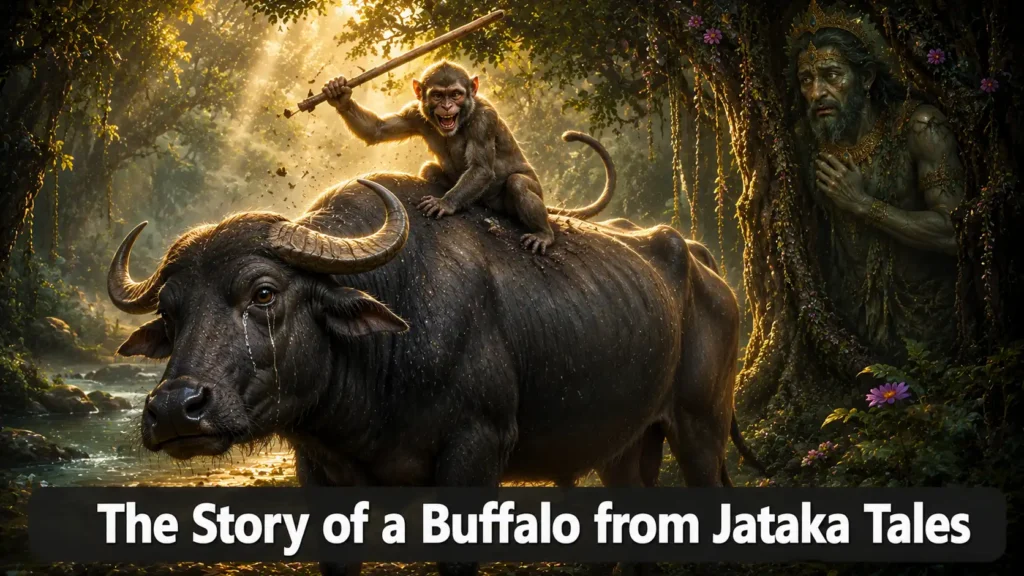
Read the previous story: The Story of a Buffalo from Jataka Tales – The Gentle Giant Who Practiced Forbearance

Get the ThePoemStory App — Read Poems Anywhere