The Story of the Great Ape from Jataka Tales: The Kind Ape Who Forgave His Would-Be Killer
A timeless tale of kindness and karmic consequence from the Buddha Jataka Tales, exploring the depths of Jataka Stories Buddhism, the profound lessons of the Buddha Life Story, and the transformative power of ancient Buddhist Stories.
Introduction: The Compassionate Ape
The Story of the Great Ape from Jataka Tales is a powerful tale of kindness, ingratitude, and the inescapable law of karma. It recounts the Bodhisatta’s birth as a great ape who lived alone like an ascetic in the Himalayan forest. The Story of the Great Ape from Jataka Tales illustrates the virtue of compassion even in the face of betrayal.
This Jataka is unique in its portrayal of a being who helps another despite knowing the danger. The Story of the Great Ape from Jataka Tales shows that true compassion does not calculate the risk—it responds to suffering. The Story of the Great Ape from Jataka Tales teaches that kindness is its own reward, regardless of how it is received.
As we journey through The Story of the Great Ape from Jataka Tales, we discover that no one can escape the consequences of their actions. The Story of the Great Ape from Jataka Tales reminds us that karma is a law of nature, not a punishment imposed from outside.
Table of Contents
The Story of the Great Ape from Jataka Tales
The Ascetic Ape
In the vast and misty forests of the Himalayas, the Bodhisatta was born as a great ape. The Story of the Great Ape from Jataka Tales centres on this remarkable being who lived alone like an ascetic. Unlike other monkeys, he was kind and virtuous, his heart filled with compassion for all living creatures. The Story of the Great Ape from Jataka Tales reveals that virtue is not limited by birth or species.
The great ape survived on leaves and fruits of the forest trees. He lived a simple life, free from the desires that plague ordinary beings. The Story of the Great Ape from Jataka Tales shows that contentment comes from within, not from external possessions. The Story of the Great Ape from Jataka Tales teaches that true peace is found in simplicity and virtue.
Despite his solitary life, the great ape was not without purpose. His heart was open to all beings who might need his help. The Story of the Great Ape from Jataka Tales reveals that the Bodhisatta, even in animal form, was ready to practice compassion. The Story of the Great Ape from Jataka Tales shows that kindness is a choice we make, regardless of our circumstances.
This was the beginning of The Story of the Great Ape from Jataka Tales—a story of compassion, betrayal, and the inescapable law of karma.
The Lost Shepherd
One day, a shepherd in search of his stray cattle lost his way and wandered deep into the forest. The Story of the Great Ape from Jataka Tales reveals the shepherd’s desperate situation. Exhausted with hunger, thirst, heat, and toil, he sat at the foot of a tree, his spirit broken. The Story of the Great Ape from Jataka Tales shows that suffering can come to anyone, regardless of their station in life.
Soon, his eyes fell upon a tinduka tree laden with fruits. The fruits looked ripe and inviting. The hungry shepherd, driven by his desperate need for food, climbed the tree without thinking. The Story of the Great Ape from Jataka Tales reveals the folly of acting without caution. The shepherd overlooked the roots of the tree, which had grown out of a sloping cliff over a waterfall.
When he reached a branch laden with ripe tindukas, he reached out to pluck them. But the branch could not sustain his weight. It broke off, and the shepherd fell down into a pit. The Story of the Great Ape from Jataka Tales reveals the shepherd’s fall—both physical and metaphorical. Luckily, his bones were not broken. Yet, it was impossible for him to find an exit. The Story of the Great Ape from Jataka Tales shows that sometimes our desperate actions lead us into even greater danger.
The shepherd cried out for help, but no one came. He was trapped, alone, and helpless. The Story of the Great Ape from Jataka Tales reveals the depths of his despair. But fate had other plans for him.
This was the moment when The Story of the Great Ape from Jataka Tales would take an unexpected turn.
The Great Ape’s Rescue
As a matter of chance, the great ape was passing by and saw the man in his distress. The Story of the Great Ape from Jataka Tales reveals the ape’s compassionate heart. He did not hesitate, did not calculate the risk. He simply responded to the suffering of another being. The Story of the Great Ape from Jataka Tales shows that true compassion acts spontaneously.
Feeling pity for the man, the great ape began the difficult task of rescuing him. The pit was deep, and the man was heavy. The ape exerted himself greatly, using all his strength to lift the man out of the pit. The Story of the Great Ape from Jataka Tales reveals the effort and sacrifice involved in true compassion. The Story of the Great Ape from Jataka Tales teaches that helping others often requires great effort.
Finally, after much exertion, the great ape succeeded in pulling the man to safety. The man was exhausted and trembling, but he was alive. The Story of the Great Ape from Jataka Tales reveals the man’s relief and gratitude. He had been saved from certain death.
To ease himself after his great exertion, the exhausted ape wanted to have some rest. He was tired, his muscles ached, and he needed to recover his strength. The Story of the Great Ape from Jataka Tales reveals the ape’s vulnerability and trust. He turned to the man he had just rescued and spoke gently.
“Friend,” the ape said, “I have saved you from the pit. Now I need to rest. Please guard me while I sleep. Protect me from any danger that might come.”
This was the question at the heart of The Story of the Great Ape from Jataka Tales—would the man repay kindness with gratitude or with betrayal?
The Man’s Betrayal
But the man was not grateful. The Story of the Great Ape from Jataka Tales reveals the darkness that can lurk in the human heart. His mind, instead of being filled with gratitude, was filled with selfish thoughts. He looked at the sleeping ape and saw not his savior but a source of meat. The Story of the Great Ape from Jataka Tales shows that greed and selfishness can corrupt even those who have been shown great kindness.
“I am lost in this forest,” the man thought. “I may never find my way out. If I kill this ape and eat his meat, I will survive longer. His flesh will sustain me.” The Story of the Great Ape from Jataka Tales reveals the depth of the man’s ingratitude. He had been saved from certain death, and now he was planning to kill his savior.
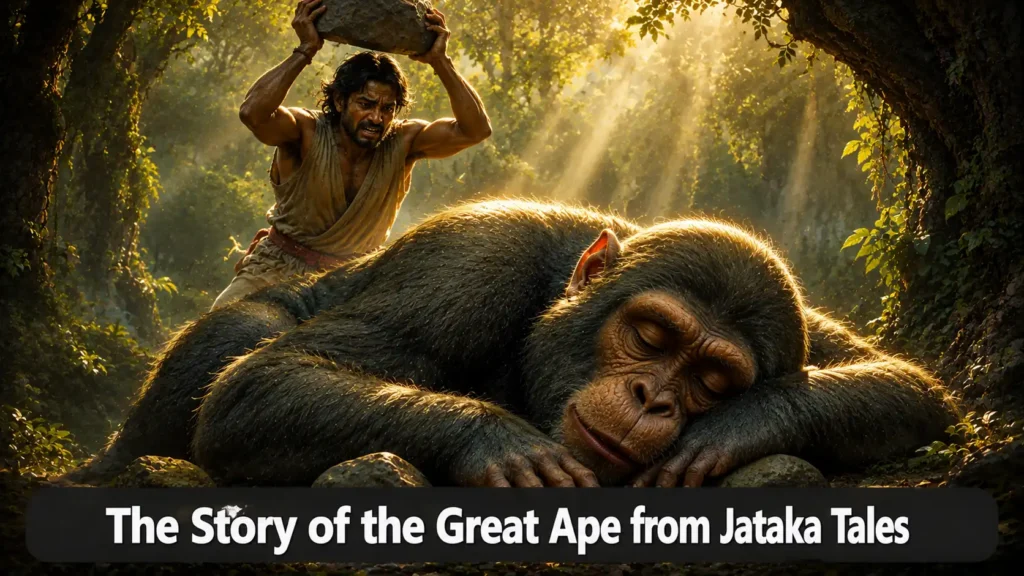
The man picked up a large piece of stone. He raised it above his head, ready to drop it on the sleeping ape. The Story of the Great Ape from Jataka Tales reveals the man’s evil intentions. He had no pity, no gratitude, no conscience.
He dropped the stone on the head of the sleeping monkey. But somehow, the stone slipped and missed the target. Nonetheless, it hurt the monkey. The ape opened his eyes in agony and saw the man standing over him with the stone in his hands.
The Story of the Great Ape from Jataka Tales reveals the ape’s shock and pain. Not just the physical pain of the wound, but the deeper pain of betrayal. The being he had just saved was now trying to kill him.
This was the tragedy of The Story of the Great Ape from Jataka Tales—the betrayal of kindness by ingratitude.
The Ape’s Words of Wisdom
When the ape opened his eyes in agony, he read the guilt written in the face of the man. The Story of the Great Ape from Jataka Tales reveals the ape’s ability to see into the man’s heart. He understood what the man had tried to do. The Story of the Great Ape from Jataka Tales shows that true wisdom sees beyond appearances.
But instead of rage or vengeance, the ape’s heart was filled with compassion. He looked at the man with pity and spoke these words:
"Brought back from the mouth of Death
When reaching the other world.
Saved from one precipice
Thou hast now fallen on the worse.
The ape’s words reveal the depth of his wisdom. The man had been saved from physical death, but he had now fallen into something far worse—the karmic consequences of his evil intentions. The Story of the Great Ape from Jataka Tales reveals the ape’s understanding of karma. The man’s attempt to kill his benefactor would bring him great suffering.
"Fie upon ignorance that spurs one to such vice and cruelty
And leads one to miseries
As it is the infatuation
Which deludes one to fall on the false hope of prosperity."
The ape continued, his voice filled with sorrow. The Story of the Great Ape from Jataka Tales reveals that ignorance is the root of all evil. The man’s ignorance had led him to believe that killing his benefactor would bring him prosperity. But in reality, it would only bring him misery.
"The pain of this wound does not aggrieve me much
As the thought
That on account of me
You have plunged into such evil
From where I or else could ever rescue thee!"
The ape’s final words reveal the depth of his compassion. The Story of the Great Ape from Jataka Tales shows that he was not concerned about his own pain. His grief was for the man who had fallen into such evil. The ape knew that he could rescue the man from the pit, but he could not rescue him from the consequences of his own actions. The Story of the Great Ape from Jataka Tales teaches that some things cannot be undone—not even by a compassionate being.
This was the wisdom at the heart of The Story of the Great Ape from Jataka Tales—the understanding that we must all face the consequences of our actions.
The Final Kindness
Despite the man’s betrayal, the compassionate ape did not abandon him. The Story of the Great Ape from Jataka Tales reveals the ape’s extraordinary forgiveness. He could have left the man to his fate. He could have warned others about the man’s evil nature. But instead, he did something remarkable.
He escorted the man to the fringe of the forest so that he could go back to his own fellow beings. The Story of the Great Ape from Jataka Tales shows that the ape’s compassion was not conditional. He had been wronged, yet he still helped the man. The Story of the Great Ape from Jataka Tales teaches that true compassion is unconditional—it does not depend on how others treat us.
The ape guided the man through the forest, showing him the way out. When they reached the edge of the forest, the ape stopped. “Go now,” he said. “Return to your own people. Live well. And remember—the consequences of your actions will follow you.”
The man, still filled with guilt, said nothing. He walked away, leaving the ape behind. The Story of the Great Ape from Jataka Tales reveals the man’s silence—the silence of shame and regret. He had been shown kindness, and he had repaid it with cruelty. The Story of the Great Ape from Jataka Tales shows that the man’s guilt was already beginning to weigh on him.
This was the final kindness of The Story of the Great Ape from Jataka Tales—the kindness of forgiveness and guidance, even to one who had tried to kill him.
The Karmic Consequence
By and by, the man’s evil manifested in his body. The Story of the Great Ape from Jataka Tales reveals the inescapable nature of karma. His skin thawed, and he was afflicted with leprosy. The disease consumed him, deforming his body and isolating him from society. The Story of the Great Ape from Jataka Tales shows that our actions have consequences that we cannot escape.
Excommunicated from the world of his own fellow beings, the man started living in a dense forest where no man dared to tread. The Story of the Great Ape from Jataka Tales reveals the man’s fate—he was now alone, suffering, and rejected. The same forest that had once been his prison had now become his home.
One day, the king of Varanasi detected him on a hunting expedition in the forest. The king mistook him to be a ghost, because his body had become deformed. The Story of the Great Ape from Jataka Tales reveals the man’s unrecognizable condition. He had become something monstrous, a shadow of his former self.
When the king came closer, he discovered to his shock that the ghost-looking being was none other than a man. Further, he was shocked when he heard the pathetic story of that man—who was still remorseful for his ungratefulness to the great ape. His miseries had no bound. The Story of the Great Ape from Jataka Tales reveals the man’s repentance, but it was too late.
The king listened to the man’s story with a heavy heart. The man wept as he recounted his betrayal of the compassionate ape. He spoke of the ape’s kindness, his own greed, and the suffering that had followed. The Story of the Great Ape from Jataka Tales reveals that the man had finally understood the depth of his wrongdoing—but understanding came too late.
Truly, he repented. But then it was too late. No one can escape the fruit of his or her own karma. The Story of the Great Ape from Jataka Tales concludes with this powerful teaching: our actions create our destiny, and we cannot escape the consequences of what we do.
Thus, The Story of the Great Ape from Jataka Tales ends with a sobering lesson. The Story of the Great Ape from Jataka Tales reminds us that ingratitude has consequences. The Story of the Great Ape from Jataka Tales teaches that we must be mindful of our actions, for they will shape our future.
Moral of the Story: The Inescapable Law of Karma
The Story of the Great Ape from Jataka Tales is a profound teaching on the inescapable law of karma. It illustrates how our actions—whether kind or cruel—create consequences that we cannot escape. The great ape’s compassion was met with betrayal, yet he remained forgiving. The man’s ingratitude led to his own suffering and isolation.
In Buddhist philosophy, karma is not a punishment imposed by an external force—it is the natural law of cause and effect. The Story of the Great Ape from Jataka Tales shows that our actions create seeds that will eventually bear fruit. The man’s attempt to kill his benefactor created seeds of suffering that would later manifest as disease and isolation.
The great ape’s forgiveness is a powerful example of the Bodhisattva’s virtue. The Story of the Great Ape from Jataka Tales shows that true compassion is not conditional—it does not depend on how others treat us. The ape was wronged, yet he still guided the man to safety. The Story of the Great Ape from Jataka Tales teaches that forgiveness is not weakness—it is the highest form of strength.
The man’s story is a warning about the dangers of ingratitude. The Story of the Great Ape from Jataka Tales reveals that ingratitude is a poison that destroys the one who harbors it. The man was shown extraordinary kindness, yet he repaid it with cruelty. The Story of the Great Ape from Jataka Tales teaches that we must never take kindness for granted.
The ape’s words—”Fie upon ignorance that spurs one to such vice and cruelty”—reveal that ignorance is the root of all evil. The Story of the Great Ape from Jataka Tales shows that ignorance leads us to believe that harming others will bring us happiness. But in reality, harming others only brings us suffering.
This Jataka also teaches that some things cannot be undone. The ape could rescue the man from the pit, but he could not rescue him from the consequences of his actions. The Story of the Great Ape from Jataka Tales reminds us that we must be mindful of our choices, for once they are made, we must live with their consequences.
In our own lives, The Story of the Great Ape from Jataka Tales invites us to examine our actions. Are we grateful for the kindness we receive? Do we repay kindness with kindness, or do we take it for granted? The Story of the Great Ape from Jataka Tales teaches that gratitude is a virtue that protects us from the consequences of ingratitude.
By exploring The Story of the Great Ape from Jataka Tales, we gain timeless wisdom about the law of karma and the power of compassion. The Story of the Great Ape from Jataka Tales guides us toward a life of gratitude, kindness, and mindful action.
In our world of self-interest and ingratitude, The Story of the Great Ape from Jataka Tales invites us to examine our actions and their consequences. By exploring The Story of the Great Ape from Jataka Tales, we gain timeless wisdom about the inescapable law of karma and the power of forgiveness.
Read the previous story: The Story of the Golden Swan from Jataka Tales – The Grateful Bird Who Returned to Help His Family

Get the ThePoemStory App — Read Poems Anywhere