Story of the Mighty Fish from Jataka Tales: The Compassionate Fish Who Called the Rains
A timeless tale of compassion and the power of virtue from the Buddha Jataka Tales, exploring the depths of Jataka Stories Buddhism, the profound lessons of the Buddha Life Story, and the transformative power of ancient Buddhist Stories.
Introduction: The Mighty Fish
Story of the Mighty Fish from Jataka Tales is a powerful tale of compassion, virtue, and the extraordinary power of a solemn act of truth. It recounts the Bodhisatta’s birth as a mighty fish living in a pond near Jetavana, who witnessed the suffering of his fellow creatures during a terrible drought. The Story of the Mighty Fish from Jataka Tales illustrates the perfection of compassion and the efficacy of truth.
This Jataka is unique in its demonstration of how virtue can move even the forces of nature. The Story of the Mighty Fish from Jataka Tales shows that true goodness has power beyond our ordinary understanding. The Story of the Mighty Fish from Jataka Tales teaches that compassion, when united with truth, can bring about miraculous results.
As we journey through The Story of the Mighty Fish from Jataka Tales, we discover that even the humblest being can make a difference through virtue. The Story of the Mighty Fish from Jataka Tales reminds us that we are all connected, and our actions affect those around us.
Table of Contents
The Story of the Mighty Fish from Jataka Tales
The Virtuous Fish
In the serene surroundings of Jetavana, near the city of Savatthi, there was a pond where grew myriad climbing plants. The Story of the Mighty Fish from Jataka Tales centres on a remarkable creature who lived in this pond—a mighty fish of extraordinary virtue. He was pious, righteous, and herbivorous, living in harmony with all the creatures around him. The Story of the Mighty Fish from Jataka Tales reveals that virtue is not limited to human beings—it can be found in all forms of life.
The mighty fish was unlike others of his kind. His heart was filled with compassion for all living beings. He did not harm any creature, nor did he take more than he needed. The Story of the Mighty Fish from Jataka Tales shows that true virtue is expressed through our actions toward others. The fish’s goodness was not merely a passive quality—it was an active force that would soon be tested.
He lived peacefully in the pond, surrounded by the beauty of nature. The lotus flowers bloomed around him, and the climbing plants provided shade and shelter. The Story of the Mighty Fish from Jataka Tales reveals the peace that comes from a life of virtue. The fish was content, grateful, and compassionate.
But The Story of the Mighty Fish from Jataka Tales would soon take a dramatic turn. A great calamity was approaching—one that would test the fish’s virtue and reveal the power of his goodness.
This was the beginning of The Story of the Mighty Fish from Jataka Tales—a story of compassion, truth, and the power of virtue.
The Great Drought
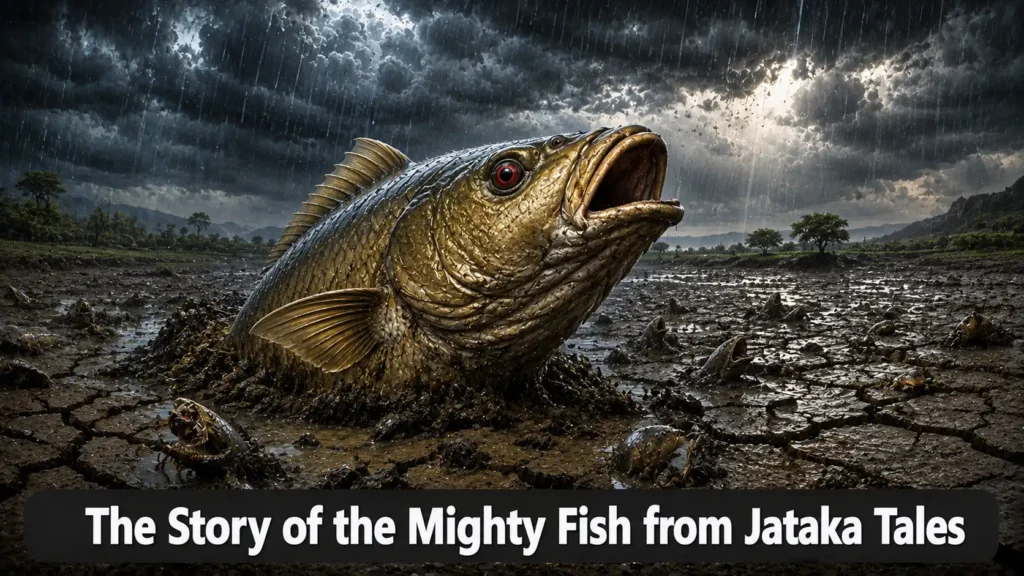
Then, a terrible drought struck the land. The Story of the Mighty Fish from Jataka Tales reveals the devastation that followed. Crops withered and died. Water sources dried up completely. The pond where the mighty fish lived began to shrink, its waters evaporating under the relentless sun. The Story of the Mighty Fish from Jataka Tales shows the suffering that drought brings to all living beings.
The fishes and tortoises were buried under the mud. The Story of the Mighty Fish from Jataka Tales reveals the desperate situation of the water creatures. They could not move, could not escape, could not survive. All the water creatures became vulnerable and easy prey for the birds and beasts. The Story of the Mighty Fish from Jataka Tales shows that in times of scarcity, the weak suffer the most.
Birds descended from the skies, their sharp beaks ready to pluck the helpless creatures from the drying mud. Beasts came to the edge of the pond, their eyes scanning for easy prey. The Story of the Mighty Fish from Jataka Tales reveals the horror of the situation—creatures who had once lived in harmony were now being devoured by predators.
But the mighty fish was not like the others. He was not vulnerable—his size and strength protected him from most predators. Yet he could not bear to watch the suffering of his fellow creatures. The Story of the Mighty Fish from Jataka Tales reveals his compassionate heart. His own safety meant nothing to him if his friends were suffering.
This was the question at the heart of The Story of the Mighty Fish from Jataka Tales—what would the fish do to save his suffering companions?
The Fish’s Compassion
Seeing the lot of his fellow creatures, who were being devoured by crows and other birds, the mighty fish’s heart filled with compassion. The Story of the Mighty Fish from Jataka Tales reveals the depth of his empathy. He could not stand by while others suffered. He was determined to do something to save them.
The fish thought deeply about what he could do. He was trapped in the mud, just like the others. His strength alone could not save them. The Story of the Mighty Fish from Jataka Tales shows that even the strongest being cannot overcome every obstacle alone. But the fish had something that others did not—he had virtue.
He knew about the power of truth. In Buddhist tradition, a solemn act of truth—a saccakiriya—was believed to be efficacious. The Story of the Mighty Fish from Jataka Tales reveals the fish’s understanding of this ancient practice. If one was truly virtuous, a statement of truth could bring about miraculous results.
The fish resolved to make such an act. He would call upon the power of his virtue to save his friends. The Story of the Mighty Fish from Jataka Tales shows that true compassion is not passive—it moves us to action. The fish could have saved himself, but he chose instead to risk everything for others.
This was the moment of supreme courage in The Story of the Mighty Fish from Jataka Tales—the moment when the fish would put his virtue to the ultimate test.
The Solemn Act of Truth
With determination in his heart, the mighty fish began to move. The Story of the Mighty Fish from Jataka Tales reveals his effort. Parting asunder the black mud, he came to the surface fearlessly. He did not hide, did not cower. He emerged with courage and purpose.
Opening his ruby-red eyes, he made a solemn act of the “Perfection of Goodness.” The Story of the Mighty Fish from Jataka Tales reveals the solemnity of the moment. He spoke with conviction and truth:
“I am virtuous. I have never harmed any living being. I have lived a life of compassion and piety. If this is true, then let the heavens respond. Let Pajjuna, the lord of heaven, shower rain upon this land and relieve my friends from their suffering.”
The Story of the Mighty Fish from Jataka Tales reveals the fish’s unwavering faith in the power of truth. He did not doubt his virtue. He knew that he had lived a righteous life. His words were not empty—they were backed by a lifetime of goodness.
This was the question at the heart of The Story of the Mighty Fish from Jataka Tales—would the power of truth be strong enough to move the heavens?
The fish’s act of truth was not a selfish prayer. It was a plea for the welfare of others. The Story of the Mighty Fish from Jataka Tales shows that true virtue is not self-serving—it is always directed toward the benefit of all beings.
This was the climax of The Story of the Mighty Fish from Jataka Tales—the moment when the fish’s virtue would be tested by the forces of nature.
The Response of Heaven
Pajjuna, the lord of heaven who commands the rains, heard the fish’s solemn act of truth. The Story of the Mighty Fish from Jataka Tales reveals the extraordinary response. Pajjuna was moved by the fish’s virtue and compassion. He responded to the call and obeyed the fish like his disciple.
Dark clouds gathered in the sky. The wind began to blow. Thunder rumbled in the distance. The Story of the Mighty Fish from Jataka Tales shows the heavens responding to the fish’s truth. The drought that had plagued the land was about to end.
Pajjuna caused heavy rains to fall. The rain poured down in torrents, soaking the parched earth. The Story of the Mighty Fish from Jataka Tales reveals the abundance of the rain—it was not a gentle shower but a powerful deluge. The land was saturated with water.
The pond began to fill once again. The mud was washed away, and the water creatures were freed from their suffering. The Story of the Mighty Fish from Jataka Tales shows the relief and joy that followed. The drought was over. The creatures were saved.
This saved and relieved all his companions. The Story of the Mighty Fish from Jataka Tales reveals the success of the fish’s act of truth. His virtue had proven powerful enough to change the course of nature. The Story of the Mighty Fish from Jataka Tales teaches that true goodness has power beyond our ordinary understanding.
Thus, The Story of the Mighty Fish from Jataka Tales concluded with the fish’s companions saved through his compassion and virtue. The Story of the Mighty Fish from Jataka Tales reminds us that even the humblest being can make a difference through goodness and truth.
The fish’s story became a legend, passed down through the ages. The Story of the Mighty Fish from Jataka Tales shows that virtue is not just a personal quality—it has the power to benefit all beings. The Story of the Mighty Fish from Jataka Tales teaches that when we live with compassion and truth, we can change the world.
Moral of the Story: The Power of Truth and Compassion
The Story of the Mighty Fish from Jataka Tales is a profound teaching on the power of truth and the efficacy of virtue. It illustrates the Buddhist concept of saccakiriya—a solemn act of truth that can bring about miraculous results. The fish’s virtue was not just a passive quality—it was an active force that moved the heavens themselves.
In Buddhist philosophy, truth is considered one of the highest virtues. Story of the Mighty Fish from Jataka Tales shows that truth, when combined with compassion, has extraordinary power. The fish’s act of truth was effective because it was backed by a lifetime of virtue. His words were not empty—they were a reflection of his inner purity.
The fish’s compassion is a powerful example of the Bodhisattva’s ideal. The Story of the Mighty Fish from Jataka Tales shows that true compassion is not limited to our own kind—it extends to all beings. The fish’s heart was filled with compassion for his fellow creatures, and this compassion moved him to act.
The drought represents the suffering that can come to all beings. The Story of the Mighty Fish from Jataka Tales shows that suffering is universal—it does not discriminate. The water creatures, regardless of their nature, all suffered together. The fish understood that their suffering was his suffering.
Pajjuna’s response to the fish’s act of truth reveals that the universe responds to virtue. The Story of the Mighty Fish from Jataka Tales teaches that goodness is not ignored—it has power and efficacy. When we live with compassion and truth, we align ourselves with the natural order of the universe.
This Jataka also teaches the importance of courage. The fish emerged from the mud fearlessly. The Story of the Mighty Fish from Jataka Tales shows that virtue requires courage. It is not always easy to stand up for what is right, but it is necessary. The fish’s courage saved his companions.
In our own lives, The Story of the Mighty Fish from Jataka Tales invites us to examine our own virtue. Are we living with compassion and truth? Are we willing to act for the benefit of others? The Story of the Mighty Fish from Jataka Tales teaches that even the smallest act of goodness can have far-reaching consequences.
By exploring The Story of the Mighty Fish from Jataka Tales, we gain timeless wisdom about the power of truth and the importance of compassion. The Story of the Mighty Fish from Jataka Tales guides us toward a life of virtue, courage, and service to all beings.
In our world of suffering and hardship, The Story of the Mighty Fish from Jataka Tales invites us to examine our own virtue and compassion. By exploring The Story of the Mighty Fish from Jataka Tales, we gain timeless wisdom about the power of truth and the importance of acting for the benefit of all beings.
Read the previous story: The Story of the Great Ape from Jataka Tales – The Kind Ape Who Forgave His Would-Be Killer

Get the ThePoemStory App — Read Poems Anywhere