The Story of the Lion and the Jackal from Jataka Tales: The Foolish Jackal Who Learned Too Late
A timeless tale of pride and folly from the Buddha Jataka Tales, exploring the depths of Jataka Stories Buddhism, the profound lessons of the Buddha Life Story, and the transformative power of ancient Buddhist Stories.
Introduction: The Foolish Jackal
The Story of the Lion and the Jackal from Jataka Tales is a powerful tale of pride, folly, and the tragic consequences of overestimating one’s abilities. The Story of the Lion and the Jackal from Jataka Tales recounts the tale of a lowly jackal who, through association with a mighty lion, developed delusions of grandeur. The Story of the Lion and the Jackal from Jataka Tales illustrates the dangers of pride and the importance of knowing one’s limitations.
This tale is unique in its portrayal of a being who forgot his place. The Story of the Lion and the Jackal from Jataka Tales shows that pride comes before a fall. Those who overestimate their abilities often meet a tragic end. As we journey through The Story of the Lion and the Jackal from Jataka Tales, we discover that wisdom lies in knowing ourselves.
Table of Contents
The Story of the Lion and the Jackal from Jataka Tales
The Mighty Lion
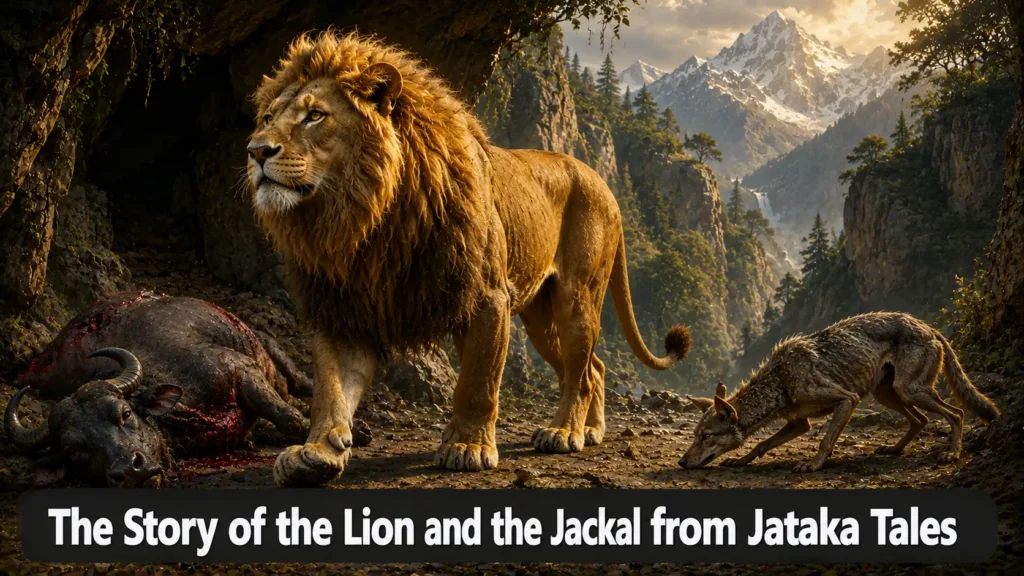
Once upon a time, in the majestic Himalayas, there lived a mighty lion. The Story of the Lion and the Jackal from Jataka Tales centres on this powerful creature who ruled the forest with strength and dignity. He was a formidable hunter, feared and respected by all the animals of the region.
The lion made his home in a cave nestled among the rocky cliffs of the mountains. From this vantage point, he surveyed his domain and hunted for his food. His strength was legendary—no creature could stand against him. The Story of the Lion and the Jackal from Jataka Tales reveals the lion’s power and the respect he commanded.
One day, after a successful hunt, the lion killed and ate a buffalo. The carcass lay where it had fallen. The Story of the Lion and the Jackal from Jataka Tales shows that in the natural world, even the leftovers of the mighty provide sustenance for the humble. The lion was content, his hunger satisfied, and he began his journey back to his cave.
The Jackal’s Proposal
As the lion walked through the forest, he noticed a jackal lying prostrate before him. The jackal was emaciated, thin, and desperate for food. The Story of the Lion and the Jackal from Jataka Tales reveals the jackal’s cunning nature. He had observed the lion’s habits and knew that the mighty hunter always left leftovers behind.
“Why do you lie like this, Jackal?” the lion asked, curious about the creature’s strange behavior.
The jackal lifted his head and spoke with humility. “Sir! I would like to be your servant. I will follow you, serve you, and be loyal to you. In return, I ask only for the leftovers of your kills.”
The lion was amused by the jackal’s request. The Story of the Lion and the Jackal from Jataka Tales shows that the lion was generous and kind-hearted. He accepted the jackal’s proposal and treated him with affection. From that day forward, the jackal followed the lion and fed on the remains of his kills.
The Jackal’s Pride
Since that day, the lion offered the jackal the leftovers of the animals he killed. The jackal’s diet improved dramatically. The Story of the Lion and the Jackal from Jataka Tales reveals how the jackal transformed from an emaciated creature into a bulging, well-fed one. The steady supply of meat fattened him up quickly.
But something else grew alongside his body—his pride. The jackal began to forget his humble origins. He looked at his full belly and thought himself powerful. He watched the lion’s hunts and began to imagine that he, too, possessed such strength. The Story of the Lion and the Jackal from Jataka Tales shows how pride can corrupt the humblest heart.
He fostered the false idea of having equal power to that of the lion. His arrogance grew with each passing day. He forgot that he was a scavenger, not a hunter. He forgot that his strength was borrowed, not his own. The Story of the Lion and the Jackal from Jataka Tales teaches that pride makes us forget who we truly are.
This was the question at the heart of The Story of the Lion and the Jackal from Jataka Tales—would the jackal’s pride lead him to destruction?
The Lion’s Warning
One day, the jackal approached the lion with an audacious declaration. “O lion! So far I have been fed on your leftovers. But today, I shall offer you my leftovers. I shall kill and eat an elephant and share the remains with you.”
The lion was astonished by the jackal’s words. He knew the jackal’s nature, his limitations, and his true place in the natural order. The Story of the Lion and the Jackal from Jataka Tales reveals the lion’s wisdom and concern for his foolish companion.
He advised the jackal gently but firmly. “Refrain from any such act,” the lion warned. “You do not belong to the species of lion-like animals. You lack the strength, the size, and the power to kill a strong elephant. You are a jackal—respect what you are.”
But the haughty and foolish jackal did not listen to the lion. The Story of the Lion and the Jackal from Jataka Tales shows that pride deafens us to wise counsel. The jackal was determined to prove himself, even if it meant risking his life.
This was the moment when The Story of the Lion and the Jackal from Jataka Tales would take its tragic turn.
The Jackal’s Folly
Feigning like a lion, the jackal moved out of the cave with false confidence. He was determined to prove his strength and silence any doubts. The Story of the Lion and the Jackal from Jataka Tales reveals the jackal’s pathetic attempt to imitate his master.
He uttered the cry of a jackal thrice, as if it was the cry of a mighty lion. But no one was fooled. The forest creatures recognized the jackal’s pathetic wail for what it was—a weak imitation. The Story of the Lion and the Jackal from Jataka Tales shows that we cannot pretend to be what we are not.
Undeterred, the jackal looked for an elephant. He saw one at the base of the mountain. The elephant was massive, powerful, and unaware of the foolish creature watching from above. The jackal jumped at the large animal from the top of the mountain.
But instead of falling on the elephant’s back as he had planned, he fell on its feet. The Story of the Lion and the Jackal from Jataka Tales reveals the jackal’s complete failure—he had overestimated his abilities and underestimated his target.
The Tragic End
The elephant, without paying much notice to the existence of the jackal, lifted his fore-leg and placed it on his head. The weight was immense. The Story of the Lion and the Jackal from Jataka Tales reveals the gruesome end of the foolish jackal. His skull was mashed instantly.
Thus the foolish jackal was killed instantly. His pride had led him to his destruction. The Story of the Lion and the Jackal from Jataka Tales shows that those who overestimate their abilities often meet a tragic fate. The jackal had dreamed of being a lion, but he was only a jackal.
The lion, who had witnessed the entire show from the top of the precipice, looked down upon the scene. The Story of the Lion and the Jackal from Jataka Tales reveals the lion’s sorrow at his foolish companion’s death. He had warned the jackal, but the jackal had refused to listen.
In his grief, the lion uttered these wise words:
"A reckless and haughty being
Is thus bound to meet his doom."
Thus, The Story of the Lion and the Jackal from Jataka Tales concludes with a powerful lesson: pride leads to destruction, and wisdom lies in knowing ourselves. The Story of the Lion and the Jackal from Jataka Tales reminds us that we must be humble and recognize our limitations.
Moral of the Story: The Danger of Pride
The Story of the Lion and the Jackal from Jataka Tales is a profound teaching on the dangers of pride and the importance of knowing one’s place. It illustrates how arrogance can blind us to our true nature and lead to our destruction. The jackal’s pride made him forget his origins and overestimate his abilities.
In Buddhist philosophy, humility is a virtue that protects us from the folly of pride. The Story of the Lion and the Jackal from Jataka Tales shows that those who remain humble and grounded are safe from harm. The jackal’s arrogance was his undoing—he could have lived peacefully if he had accepted his nature.
The lion’s warning is a reminder that wise counsel should be heeded. The Story of the Lion and the Jackal from Jataka Tales reveals that those who love us will tell us the truth, even when it is hard to hear. The lion warned the jackal out of genuine concern, but the jackal refused to listen.
The jackal’s attempt to imitate a lion is a powerful metaphor for the dangers of pretending to be what we are not. The Story of the Lion and the Jackal from Jataka Tales teaches that authenticity is a virtue. We must accept ourselves as we are, rather than trying to be something we can never become.
This Jataka also teaches the importance of knowing our limits. The jackal could have lived a long, contented life as a scavenger. But his desire for glory led to his death. The Story of the Lion and the Jackal from Jataka Tales reminds us that ambition must be tempered with wisdom.
The lion’s final words—”A reckless and haughty being is thus bound to meet his doom”—summarize the lesson of the tale. Recklessness and pride inevitably lead to destruction. The Story of the Lion and the Jackal from Jataka Tales teaches us to be humble, to know ourselves, and to accept wise counsel.
In our own lives, The Story of the Lion and the Jackal from Jataka Tales invites us to examine our own pride. Do we overestimate our abilities? Do we refuse to listen to wise counsel? The Story of the Lion and the Jackal from Jataka Tales guides us toward a life of humility and self-awareness.
By exploring The Story of the Lion and the Jackal from Jataka Tales, we gain timeless wisdom about the danger of pride and the importance of knowing ourselves. It teaches us to be humble, to listen, and to accept our true nature.
In our world of ambition and pride, The Story of the Lion and the Jackal from Jataka Tales invites us to examine our own humility. By exploring this ancient tale, we gain timeless wisdom about the danger of overestimating ourselves and the importance of accepting wise counsel.
Read the previous story: The Story of the Monkey King from Jataka Tales – The Wise Leader Who Foresaw Disaster
Get the ThePoemStory App — Read Poems Anywhere