Sergeant Henry Johnson – The Harlem Hellfighter Who Fought Off a German Raiding Party with a Knife.
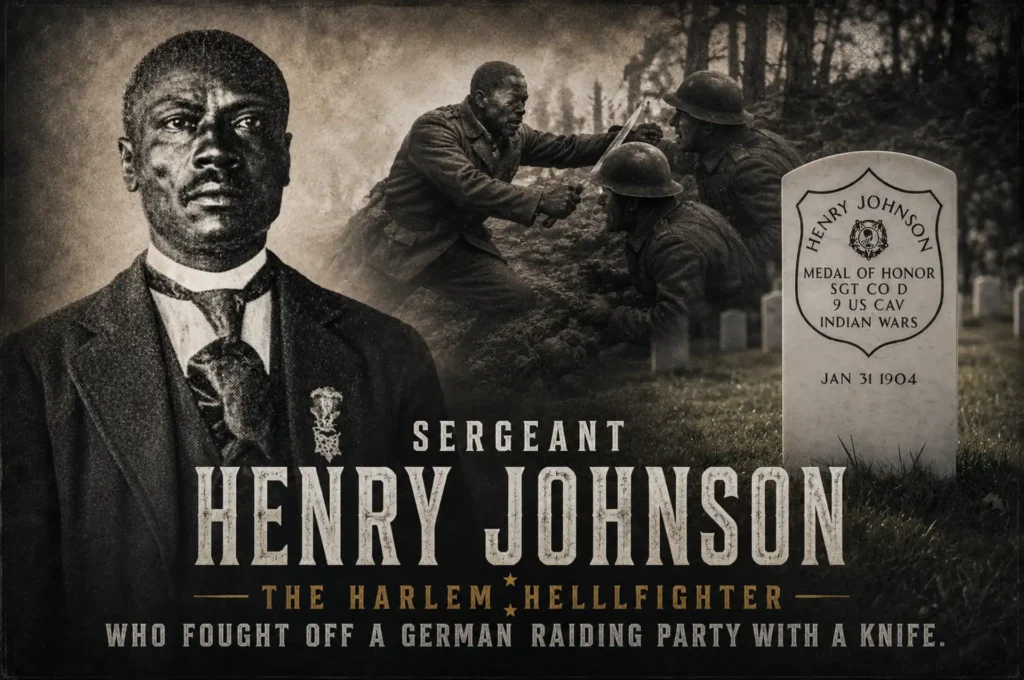
Sergeant Henry Johnson
Introduction: One Man Against an Army
In the pitch‑black woods of France’s Argonne Forest, just after 2:00 AM on May 15, 1918, a 25‑year‑old former railroad porter from Albany, New York, stood sentry duty. He weighed only 130 pounds and stood barely five‑foot‑four. But in the next hour, he would do something that forced over 20 German soldiers to retreat – armed with nothing but a jammed rifle, a box of grenades, and finally, a 14‑inch bolo knife.
His name was Private Henry Johnson of the 369th Infantry Regiment – the “Harlem Hellfighters.” By dawn, he would be called the “Black Death.” And nearly a century later, President Barack Obama would place the Medal of Honor – America’s highest military award – around a ceremonial portrait of a man who died poor and forgotten. This is his true story.
Historical Context: The Western Front & The Harlem Hellfighters
The Battle of Argonne Forest in 1918
By the spring of 1918, World War I was entering its final, bloodiest phase on the Western Front. Germany launched a massive offensive – the Kaiserschlacht – hoping to break the Allied lines before millions of fresh American troops could tip the balance. The Argonne Forest region in France’s Champagne district became a hell of mud, barbed wire, and constant raiding parties. German forces would sneak through no‑man’s‑land at night, capture prisoners for intelligence, and slip back into their trenches before dawn.
Sentries like Henry Johnson and his comrade, 17‑year‑old Private Needham Roberts, were the first line of defense. Their job was to sit in a forward listening post, watch for movement, and raise the alarm. If a German raiding party found them first, they would almost certainly be killed or captured.
The 369th Infantry Regiment – The Harlem Hellfighters
Johnson served in the 369th Infantry Regiment, an all‑African American unit originally called the 15th New York National Guard. When the regiment arrived in France, the U.S. Army, still strictly segregated, refused to let Black soldiers fight alongside white Americans. General John J. Pershing transferred the entire regiment to the French Fourth Army, which was desperate for troops. The French had no racial segregation policies – they welcomed the Americans as equals.
The 369th was nicknamed the “Harlem Hellfighters” by their German enemies, who grew to fear their ferocity in combat. The regiment spent 191 days in front‑line trenches – longer than any other American unit of its size – and suffered over 1,400 casualties. By the end of the war, 171 of its members had received the French Croix de Guerre, the nation’s highest valor award. Henry Johnson would become the first American to receive it.
Who Was Henry Johnson Before the War?
Early Life in North Carolina and Albany
William Henry Johnson was born around July 15, 1892 (some records say 1897) in Winston‑Salem, North Carolina. His father was a laborer, and the family moved to Albany, New York, while Henry was still a teenager. In Albany, he held a string of odd jobs: soda mixer at a pharmacy, chauffeur, laborer in a coal yard, and finally a “redcap” porter at Albany’s Union Station, helping passengers carry their luggage onto trains.
He was a quiet, hardworking young man. On September 17, 1917, just months after enlisting, he married Georgia Edna Jackson of Great Barrington, Massachusetts. The marriage lasted only a few years – the war would destroy much of what he had built.
Enlistment into the 15th New York National Guard
On June 5, 1917 – two months after the United States entered World War I – Johnson enlisted in the all‑Black 15th New York National Guard. The unit trained at segregated Camp Wadsworth in South Carolina, where Black soldiers were subjected to racist abuse and menial labor while white soldiers trained for combat. When the regiment arrived in France on January 1, 1918, they were initially assigned to unloading ships and building roads – not fighting. But by mid‑March, the French Army, facing massive casualties, requested the regiment be attached to their front lines. Finally, Henry Johnson would get his chance to fight.
The Medal of Honor Citation: What Henry Johnson Did
The Setup – Outpost 20, Argonne Forest
On May 14, 1918, Johnson and his squad mate, 17‑year‑old Private Needham Roberts, were assigned to listening post Outpost 20, a forward position on the western edge of the Argonne Forest. Their shift ran from midnight to 4:00 AM. They were young, inexperienced, and isolated – cut off from any immediate support.
Just after 2:00 AM, Johnson heard the sound of wire cutters on the barbed fence in front of their position. German soldiers were sneaking through. Johnson tossed a grenade toward the sound. A split‑second later, the night exploded. A German raiding party – at least 12 to 20 soldiers – opened fire and threw their own “potato masher” grenades.
The Fight – Grenades, Rifle, and Finally a Knife
Here is the official Medal of Honor citation, as recorded by the U.S. Army and published by the Congressional Medal of Honor Society:
“Private Henry Johnson distinguished himself by extraordinary acts of heroism at the risk of his life above and beyond the call of duty while serving as a member of Company C, 369th Infantry Regiment, 93d Infantry Division, American Expeditionary Forces on May 15, 1918, during combat operations against the enemy on the front lines of the Western Front in France. In the early morning hours, Private Johnson and another soldier were on sentry duty at a forward outpost when they received a surprise attack from a German raiding party consisting of at least 12 soldiers.
While under intense enemy fire and despite receiving significant wounds, Private Johnson mounted a brave retaliation, resulting in several enemy casualties. When his fellow soldier was badly wounded and being carried away by the enemy, Private Johnson exposed himself to grave danger by advancing from his position to engage the two enemy captors in hand‑to‑hand combat. Wielding only a knife and gravely wounded himself, Private Johnson continued fighting, defeating the two captors and rescuing the wounded soldier. Displaying great courage, he continued to hold back the larger enemy force until the defeated enemy retreated leaving behind a large cache of weapons and equipment.”
Now, let me break down what that citation means in real, brutal detail.
Phase 1 – The Grenade Exchange: Roberts was hit early by shrapnel – his hip and arm torn open. Johnson dragged him into a trench, handed him a pile of grenades, and began throwing them as fast as he could. German grenades exploded around him. Shrapnel sliced his face, his back, his arms.
Phase 2 – Rifle Fire: Johnson fired his French‑issued rifle until he ran out of ammunition. While reloading, he accidentally mixed in the wrong caliber ammunition – the rifle jammed. Now he had no working firearm.
Phase 3 – Hand‑to‑Hand Combat: Germans swarmed into the trench. Johnson used his jammed rifle as a club, swinging it until the wooden stock split in half. A German soldier hit him in the head with a rifle butt – Johnson went down. As he struggled to his feet, he saw two Germans dragging the wounded Roberts away as a prisoner.
Phase 4 – The Bolo Knife: Johnson pulled out his last weapon – an M‑1909 bolo knife, a heavy 14‑inch blade designed for clearing brush. He charged the Germans, slashing wildly. He stabbed one in the stomach, another in the ribs, and drove the blade through a third’s head. He killed a German lieutenant before taking a bullet to his arm – but he kept fighting. The surviving Germans, stunned by his ferocity, dropped Roberts and fled into the darkness, leaving behind weapons, equipment, and puddles of blood.
When dawn came, French soldiers found Johnson slumped against a tree, his uniform shredded, covered in his own blood and the blood of his enemies. He had suffered 21 separate wounds – bayonet stabs in his back, knife cuts on his arms and face, bullet wounds in his head, arm, and side. Roberts was alive, too. Both had survived. The German raiding party, by contrast, had suffered at least 4 confirmed dead and as many as 20 wounded or dead.
Immediate Aftermath – Wounds, Survival, and Recognition
Johnson was evacuated to a French field hospital, where doctors spent hours stitching him back together. His back had been slashed open by a bayonet – one wound alone required 22 stitches. He would carry scars and pain for the rest of his life.
News of the “Battle of Henry Johnson” spread through the trenches within days. French officers visited him in the hospital. He was promoted to Sergeant on the spot. Within weeks, the French government awarded him the Croix de Guerre avec Palme – the nation’s highest award for valor, usually reserved for entire units or exceptional battlefield leaders. Johnson was the first American soldier – of any race – to receive this honor.
The French citation read, in part: “He offered a perfect example of bravery and dedication. … He put one man out of action with a gunshot and seriously injured two others with a knife. Although he himself had received three gunshot wounds and injuries from grenades, he still went to the aid of his injured comrade and continued to fight until the Germans fled.”
Theodore Roosevelt Jr., son of the former president and himself a decorated officer, later called Johnson “one of the five bravest soldiers in the war.”
How Henry Johnson Was Honored – The Long Road to the Medal of Honor
Initial Recognition – The Croix de Guerre (1919)
When the 369th Regiment returned to New York in February 1919, they were celebrated as heroes. Over 3,000 Harlem Hellfighters marched up Fifth Avenue to the music of their famous bandleader James Reese Europe. Johnson, still limping from his wounds, was personally greeted by New York Governor Alfred E. Smith. There was talk of a movie contract, a street named after him, a lifetime pension.
None of it happened.
Denied by His Own Country
Despite his heroism, the U.S. Army did not award Johnson any medal. The official reason was “missing paperwork.” The real reason was race: the Army, deeply segregated and led by officers who believed Black soldiers were inferior, simply did not want to honor a Black hero in the same way they honored white ones. Johnson’s discharge records did not even list his 21 wounds. He was denied a Purple Heart and a disability allowance.
Postwar Struggle and Tragic Death
Johnson returned to Albany, but his body was broken. The 21 wounds – especially the bayonet slash to his back – left him unable to lift heavy loads or stand for long hours. He could not return to his porter job. He tried speaking tours, lecturing about the discrimination Black soldiers faced, but the tours paid poorly. His marriage fell apart. He turned to alcohol. By 1929, at just 32 or 37 years old (records vary), Henry Johnson was broke, alone, and dying.
On July 1, 1929, he died of myocarditis (heart inflammation) at Walter Reed Hospital in Washington, D.C. No official ceremony. No headlines. He was buried at Arlington National Cemetery – not under “Henry Johnson, war hero,” but under his birth name, William Henry Johnson, with no mention of his valor.
The 77‑Year Wait for Justice
For decades, his story was forgotten. Then, in the 1990s, veterans groups, his son Herman Johnson, and politicians from Albany began a relentless campaign to right the wrong.
- 1996 – President Bill Clinton posthumously awarded Johnson the Purple Heart, nearly 70 years after his death.
- 2002 – President George W. Bush awarded him the Distinguished Service Cross, the Army’s second‑highest award for valor.
- 2004 – The National Guard named the Albany armory after him.
- 2015 – After years of lobbying and a Pentagon review, President Barack Obama awarded Johnson the Medal of Honor, America’s highest military decoration, in a White House ceremony.
During the ceremony, Obama said: “We are a nation – a people – who remember our heroes. We never forget their sacrifice. And we believe it’s never too late to say, ‘Thank you.’”
The medal was presented to Command Sergeant Major Louis Wilson of the New York National Guard, as Johnson had no surviving descendants.
Legacy: How America Remembers Sergeant Henry Johnson Today
The “Black Death” Nickname
German soldiers who survived the fight gave Johnson the nickname “Black Death” – a grudging acknowledgment of his ferocity. The name stuck, and today it is featured on commemorative plaques and historical exhibits.
Fort Johnson
On June 13, 2023, the U.S. Army renamed Fort Polk in Louisiana to Fort Johnson in his honor – the first Army base named after an African American soldier.
Memorials and Schools
- Arlington National Cemetery, Section 25, Site 64 – His grave, now marked with a Medal of Honor headstone.
- Henry Johnson Boulevard, Albany – A main road named after him.
- Henry Johnson Charter School in Albany.
- New York State Military Museum in Saratoga Springs features a permanent exhibit on Johnson and the Harlem Hellfighters.
- The Henry Johnson Monument in Albany’s Washington Park – a statue of Johnson brandishing his bolo knife.
In Popular Culture
- The 2024 documentary “The Black Death: The Incredible Story of Henry Johnson” (Recoil Web).
- Multiple books, including Peter N. Nelson’s “A More Unbending Battle.”
- The “Our Colored Heroes” lithograph (1918) depicted Johnson and Roberts; General Pershing praised them for “continuing fighting after receiving wounds and despite the use of grenades by a superior force.”
Annual Commemorations
Every May 15, the New York National Guard and the city of Albany hold a ceremony at the Henry Johnson Monument, marking the anniversary of his fight.
Why This Story Still Matters
Sergeant Henry Johnson was not a general or a celebrity. He was a railroad porter who stood five foot four and weighed 130 pounds. He had no formal military training beyond basic drill. But on one night in a French forest, when faced with a raiding party of 20 German soldiers, he refused to run. He refused to surrender. He fought with a broken rifle and finally a knife – and he won.
He saved his comrade’s life. He drove the enemy back. He gave the French Army valuable intelligence from the weapons and equipment the Germans abandoned. And then he returned home to a country that refused to honor him for nearly a century, simply because of the color of his skin.
His story is not only about valor. It is also about the courage to keep fighting – even after the battle is over. Johnson spent his last years broken, poor, and forgotten. But he did not give up. Neither did the veterans, politicians, and family members who fought for his recognition decades after his death.
This is what real courage looks like: ordinary people doing extraordinary things in the worst conditions – and the people who refuse to let that sacrifice be forgotten.
Sources & Further Reading (Primary and Authoritative)
- Congressional Medal of Honor Society – Henry Johnson full citation. cmohs.org
- U.S. Army Medal of Honor page – Sergeant Henry Johnson. army.mil/medalofhonor/johnson
- National Archives (Rediscovering Black History blog) – “We Remember Our Heroes: Henry Johnson.” archives.gov
- The White House Archives – President Obama Medal of Honor ceremony advisory, June 2, 2015. obamawhitehouse.archives.gov
- BlackPast.org – Henry Johnson biography. blackpast.org
- Smithsonian National Museum of African American History and Culture – “Remembering the Harlem Hellfighters.” si.edu
- France24 – “Henry Johnson, Harlem soldier and forgotten WWI hero.” france24.com
- Albany Times Union / Middletown Press – 100th anniversary coverage. middletownpress.com
More Stories of Valor from ThePoemStory
- Read next: Rifleman Gabar Singh Negi VC – The 20‑Year‑Old Who Led a Bayonet Charge at Neuve Chapelle
- Read next: Khudadad Khan – The First Indian to Win the Victoria Cross (coming soon)
- Read next: Noor Inayat Khan – The Sufi Princess Who Defied the Gestapo (coming soon)

Get the ThePoemStory App — Read Poems Anywhere