Robert Frost stands as one of the colossal figures of 20th-century American poetry. Known for his accessible yet profoundly layered verses, Frost often employed the rural landscapes of New England as a canvas for exploring the deepest crevices of the human psyche. While his later works, such as “The Road Not Taken” and “Stopping by Woods on a Snowy Evening,” cemented his place in the public consciousness, it is in his early collections that we find the raw, unpolished seeds of his genius.
This Love and a Question by Robert Frost analysis examines one of the most quietly devastating poems from his debut collection, A Boy’s Will (1913). Unlike the nature-focused meditations that dominate the collection, “Love and a Question” is a narrative poem that reads like a miniature drama—a tense, morally ambiguous encounter at the threshold of a newlywed couple’s home.
The poem presents a stark moral dilemma: A stranger arrives at the door of a bridegroom on his wedding night, seeking shelter. The bridegroom must choose between the demands of hospitality and the sanctity of his new marriage. Frost refuses to provide an easy answer, leaving the question unresolved and the reader to grapple with the weight of competing moral obligations.
In this comprehensive guide, we will dissect “Love and a Question” with careful attention to its narrative structure, language, and moral complexity. We will provide a detailed Love and a Question poem summary, explore the profound themes in Love and a Question by Robert Frost, examine its masterful literary devices, and ultimately reflect on the Love and a Question meaning and what it reveals about the tension between private happiness and public responsibility.
Read and explore ThePoemStory and go through Collected Poems of Robert Frost.
for more poems explore Poetry Section
Table of Contents
The Poem – Love and a Question by Robert Frost
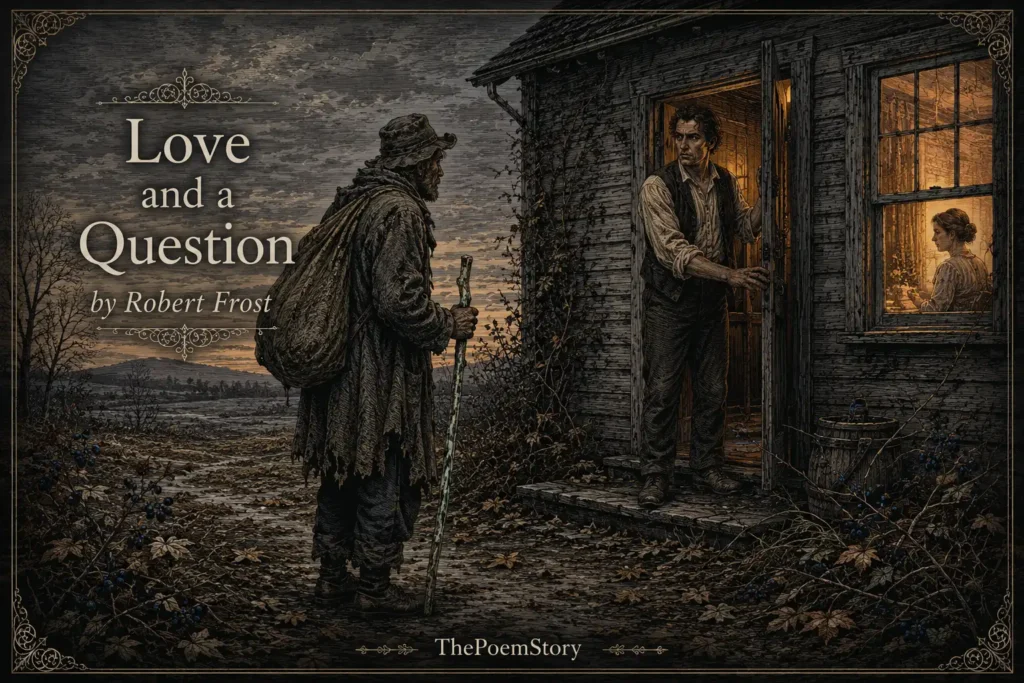
A Stranger came to the door at eve,
~ Love and a Question by Robert Frost – Analysis and Summary
And he spoke the bridegroom fair.
He bore a green-white stick in his hand,
And, for all burden, care.
He asked with the eyes more than the lips
For a shelter for the night,
And he turned and looked at the road afar
Without a window light.
The bridegroom came forth into the porch
With ‘Let us look at the sky,
And question what of the night to be,
Stranger, you and I.’
The woodbine leaves littered the yard,
The woodbine berries were blue,
Autumn, yes, winter was in the wind;
‘Stranger, I wish I knew.’
Within, the bride in the dusk alone
Bent over the open fire,
Her face rose-red with the glowing coal
And the thought of the heart’s desire.
The bridegroom looked at the weary road,
Yet saw but her within,
And wished her heart in a case of gold
And pinned with a silver pin.
The bridegroom thought it little to give
A dole of bread, a purse,
A heartfelt prayer for the poor of God,
Or for the rich a curse;
But whether or not a man was asked
To mar the love of two
By harboring woe in the bridal house,
The bridegroom wished he knew.
Love and a Question Poem Summary
Before delving into the thematic and literary depths, it is essential to establish a clear Love and a Question poem summary to ensure every reader grasps the narrative and moral complexity of this deceptively simple poem. “Love and a Question” is a narrative poem structured in five stanzas of varying lengths, each building the tension of a single, unresolved moral dilemma.
Stanza 1: The Arrival of the Stranger
The poem opens with the arrival of a stranger at the door of a bridegroom’s house at evening: “A Stranger came to the door at eve, / And he spoke the bridegroom fair.” The setting is immediately charged with significance—it is the evening of the wedding, a time of intimacy and celebration. The stranger addresses the bridegroom courteously (“spoke … fair”), suggesting he is not aggressive or threatening.
The stranger carries a “green-white stick” and his only burden is “care.” The stick may be a walking stick, suggesting he has traveled far. “Care” is a heavy burden indeed—the weight of worry, need, and perhaps hopelessness. The stranger asks for shelter, but he does so with his “eyes more than the lips,” indicating a silent, desperate plea. His eyes convey more than his words can express.
The stranger then turns and looks at the road “afar / Without a window light.” The road is dark, with no welcoming light from any window. This emphasizes his isolation and the absence of any other refuge. He is utterly alone, and the bridegroom’s house is his only hope.
Stanza 2: The Bridegroom’s Evasion
The bridegroom steps into the porch and invites the stranger to look at the sky with him. This is a strange response to a request for shelter. Instead of offering a direct answer, the bridegroom deflects: “Let us look at the sky, / And question what of the night to be, / Stranger, you and I.” The bridegroom is delaying, buying time to consider the weight of what is being asked.
The description of the setting reinforces the mood: “The woodbine leaves littered the yard, / The woodbine berries were blue.” Woodbine (honeysuckle) leaves and blue berries are autumnal images, suggesting the end of a cycle. The phrase “Autumn, yes, winter was in the wind” emphasizes the cold and the harshness of the season. This is not a time for easy generosity. The bridegroom responds with a simple, honest confession: “Stranger, I wish I knew.” He does not know what to do. He is torn.
Stanza 3: The Bride Within
The third stanza shifts focus to the bride inside the house. She is “in the dusk alone,” bending over the open fire. Her face is “rose-red with the glowing coal / And the thought of the heart’s desire.” She is warm, safe, and filled with anticipation. The fire and her blush suggest both physical warmth and romantic passion. Her “heart’s desire” is clearly the bridegroom and the wedding night ahead.
This stanza provides a sharp contrast to the cold, weary stranger outside. The bride represents everything that the bridegroom is protecting: love, intimacy, warmth, and hope. The stranger represents the opposite: cold, need, loneliness, and despair. The bridegroom stands between them.
Stanza 4: The Bridegroom’s Divided Heart
The bridegroom looks at the “weary road” but “saw but her within.” Even as he faces the stranger, his thoughts are with his bride. He wishes her heart were “in a case of gold / And pinned with a silver pin.” This is a beautiful, tender image—a wish to protect and cherish her heart as a precious treasure, safe from any harm.
The imagery of gold and silver suggests something precious, sacred, and untouchable. The bridegroom wants to preserve the purity and sanctity of his bride’s heart. This wish reveals his deep love and his desire to shield her from the world’s pain. But it also reveals the tension: he cannot protect her heart while also admitting the stranger’s “care” into their home.
Stanza 5: The Moral Question
The final stanza explicitly states the moral dilemma. The bridegroom reflects that it is easy to give bread, money, or prayers to the poor, or even to curse the rich. These are simple acts of charity or judgment—straightforward responses to simple situations.
But the real question is more difficult: “But whether or not a man was asked / To mar the love of two / By harboring woe in the bridal house.” Is he being asked to destroy his own marriage by bringing suffering and sadness into the bridal chamber? The poem ends without an answer: “The bridegroom wished he knew.”
The poem leaves the question unresolved. The bridegroom does not make a decision. The stranger’s fate is unknown. The reader is left to grapple with the same agonizing choice. This completes our Love and a Question poem summary, revealing a poem about the painful tension between love and moral duty.
Major Themes in Love and a Question by Robert Frost
Now that we have a clear understanding of the narrative, let us examine the profound themes in Love and a Question by Robert Frost. This poem is a masterclass in moral complexity, raising questions that have no easy answers.
1. The Conflict Between Love and Duty
The central theme of the poem is the conflict between private love and public duty. The bridegroom has a duty to his bride—to protect her happiness, to preserve the sanctity of their wedding night, to keep their home a place of warmth and love. But he also has a duty to the stranger—the ancient obligation of hospitality, the Christian commandment to care for the needy, the simple human duty to help a fellow traveler.
These two duties are irreconcilable. To fulfill one is to betray the other. Frost refuses to tell us which duty is more important. He leaves the question open, forcing the reader to confront the same impossible choice.
2. The Sanctity of the Bridal Chamber
The poem treats the bridal house as a sacred space. The bride is “alone” in the dusk, her face “rose-red” with the glow of the fire and the thought of her “heart’s desire.” This is a space of intimacy, passion, and vulnerability. To bring “woe” into this space would be a violation, a “marring” of love.
The imagery of gold and silver—the bride’s heart in a case of gold, pinned with a silver pin—reinforces the sacredness of the bride and her love. The bridegroom wants to protect this treasure. But the stranger’s “care” is also a kind of treasure—a human life in need. The poem does not tell us which treasure is more valuable.
3. The Weight of Moral Decision
The bridegroom is paralyzed by the weight of his decision. He cannot simply give bread or money—the easy, superficial acts of charity. He is being asked to sacrifice something far more precious: his own happiness, his bride’s joy, the sacredness of his marriage bed.
His repeated confession—”I wish I knew”—reveals the agony of moral uncertainty. There is no clear right answer. There is no divine guidance. There is only the lonely burden of choice. This theme reflects Frost’s deep skepticism of easy moral answers and his respect for the complexity of human life.
4. The Stranger as a Symbol
The stranger is a symbolic figure. He represents all the suffering and need that exists outside the boundaries of private happiness. He is the poor, the homeless, the weary, the desperate. But he also represents the intrusion of the outside world into the intimate space of love.
His “green-white stick” may symbolize a pilgrim’s staff or a traveler’s walking stick. He is on a journey, and he has no other refuge. His “care” is a burden that he carries. The stranger is not a villain; he is a fellow human being in need. This makes the bridegroom’s dilemma all the more painful.
5. The Unresolved Question
The poem’s most powerful theme is its refusal to provide an answer. Frost does not tell us what the bridegroom decides. He does not tell us what the “right” choice is. He simply presents the question and leaves it hanging in the air.
This unresolved quality is deeply unsettling. We want answers. We want to know what is right. But Frost suggests that life does not always provide clear answers. Sometimes, we must act without knowing. Sometimes, there is no perfect choice, only a choice that is less wrong than the alternative.
6. The Power of the Gaze
The poem emphasizes the power of looking. The stranger “asked with the eyes more than the lips.” The bridegroom looks at the sky and the road. The bride is “in the dusk” and “bent over the open fire.” The bridegroom “saw but her within.”
These gazes are charged with meaning. The stranger’s eyes plead for mercy. The bridegroom’s eyes are divided—one moment looking at the sky, the next looking at the road, the next looking at his bride. The bride’s eyes are fixed on the fire and her own desires. The poem suggests that what we look at reveals what we value.
Literary Devices in Love and a Question
To fully appreciate the craftsmanship of this poem, we must examine the rich array of literary devices in Love and a Question. Frost employs these techniques with his characteristic subtlety and precision, creating a narrative that is both emotionally powerful and morally ambiguous.
1. Narrative Structure
“Love and a Question” is a narrative poem, but it differs from traditional narrative poetry in one crucial respect: it has no resolution. Most narrative poems tell a story with a beginning, middle, and end. Frost gives us a beginning and a middle, but no end. The story remains unfinished. The question remains unanswered.
This structural choice is deeply intentional. The open ending mirrors the open moral question at the heart of the poem. Frost refuses to give us closure because closure would be a false comfort. Life does not always provide closure, and neither does Frost.
2. Personification
While “Love and a Question” is less reliant on personification than some of Frost’s other poems, it does contain notable examples. “Winter was in the wind” personifies winter as a presence, a force that is approaching. The “care” that the stranger carries is also personified as a burden—a weight that can be carried like a physical object.
3. Imagery
Frost’s imagery in this poem is stark and evocative:
- Visual: “green-white stick,” “woodbine leaves littered the yard,” “woodbine berries were blue,” “face rose-red with the glowing coal,” “case of gold,” “silver pin.”
- Thermal: “open fire,” “glowing coal,” “winter was in the wind.”
- Emotional: “care,” “heart’s desire,” “woe.”
The contrast between the cold outside and the warmth inside is a recurring pattern. The stranger is cold, weary, and alone. The bride is warm, safe, and surrounded by love. The bridegroom stands between these two worlds, torn between them.
4. Symbolism
Several symbols enrich the poem’s meaning:
- The Stranger: Represents suffering, need, and the intrusion of the outside world into private happiness.
- The Green-White Stick: May symbolize a pilgrim’s staff, suggesting a journey of hardship or spiritual seeking.
- The Woodbine: Honeysuckle, its blue berries and littered leaves suggesting autumn, decay, and the end of a cycle.
- The Open Fire: Symbolizes warmth, passion, love, and the domestic hearth.
- Gold and Silver: Symbolize preciousness, purity, and sacredness—the bride’s heart as a treasure to be protected.
5. Irony
There is a powerful irony in the poem’s situation. The bridegroom is experiencing the happiest night of his life—his wedding night. Yet he is being asked to share this happiness with a stranger whose very presence would “mar the love of two.” The irony is that the height of happiness coincides with the depth of moral agony.
There is also irony in the bridegroom’s desire to protect his bride. He wishes her heart in a case of gold, but his very desire to protect her is causing him to hesitate—and hesitation itself may be a form of harm.
6. Tone
The tone of the poem is quiet, tense, and morally serious. There is no melodrama, no shouting, no weeping. The characters speak calmly, but beneath the calm surface is a deep emotional turmoil. The tone reflects Frost’s characteristic restraint—the emotions are real, but they are expressed with understated dignity.
7. Rhyme and Meter
The poem employs a flexible rhyme scheme that varies from stanza to stanza. The meter is predominantly iambic, with variations that reflect the emotional tensions of the narrative. Frost often uses trimeter (three feet per line) and tetrameter (four feet per line) in alternation, creating a rhythm that is both musical and conversational.
8. Rhetorical Question
The entire poem builds toward the final rhetorical question: “But whether or not a man was asked / To mar the love of two / By harboring woe in the bridal house.” This question is not actually answered. It is left hanging, forcing the reader to supply their own answer. This rhetorical device transforms the poem from a simple narrative into a philosophical meditation.
The Deeper Meaning of Love and a Question
Beyond its surface-level narrative, the Love and a Question meaning reveals a profound meditation on the nature of moral choice and the tension between love and duty. This is where the poem transcends its historical context and speaks directly to the human condition.
The Love and a Question meaning centers on the recognition that life presents us with choices where there is no clear right answer. The bridegroom’s dilemma is not a simple matter of right versus wrong. It is a choice between two goods: love and charity. To honor his love is to deny charity. To practice charity is to violate love.
The poem challenges the moral frameworks that try to simplify such decisions. Christianity commands both hospitality (welcoming the stranger) and the sanctity of marriage. How do we choose when these commandments conflict? Frost does not tell us. He respects the complexity of the question too much to offer a simple solution.
The Love and a Question meaning also explores the nature of love itself. The bridegroom’s love for his bride is passionate, protective, and possessive. He wants to place her heart in a “case of gold” and pin it with a “silver pin.” This is a beautiful image, but it also suggests a desire to cage and control. Love wants to protect, but protection can become imprisonment.
Furthermore, the poem questions the relationship between private happiness and public responsibility. The bridegroom and bride are entitled to their joy. Their wedding night is a sacred moment. But does their private happiness exempt them from the claims of the wider world? The stranger at the door suggests that happiness cannot be an island. The world’s suffering will always knock at the door of love.
Ultimately, the Love and a Question meaning is that there are no easy answers in life. We must choose, and our choices will always involve loss. The bridegroom must lose something—either the sanctity of his wedding night or the opportunity to help a fellow human being. The poem does not tell us which loss is greater. It simply asks us to consider the weight of the question.
Reflection on Human Life
“Love and a Question” offers a timeless mirror to the human condition, and its relevance only grows in our modern world of competing moral claims and ethical dilemmas.
The Inevitability of Moral Conflict
The poem reminds us that moral conflict is an inevitable part of human life. We will all face moments when our duties conflict, when we must choose between two goods or two harms. The bridegroom’s dilemma is universal: we have all faced situations where we could not do everything we wanted to do or be everything we wanted to be.
Frost’s refusal to provide an answer is a profound moral wisdom. He does not give us a rule to follow. He does not tell us what to do. Instead, he gives us a question to sit with. This is the essence of maturity: learning to live with uncertainty and to make choices without the comfort of absolute certainty.
The Tension Between Love and Responsibility
The poem explores the tension between our responsibilities to those we love and our responsibilities to the wider world. In our modern society, we are constantly pulled in both directions. We want to protect our families, our relationships, our private joys. But we also feel the pull of public responsibility—the need to help the poor, the refugee, the stranger at the door.
Frost does not resolve this tension. He simply presents it with honesty and compassion. The bridegroom is not a villain for wanting to protect his bride. The stranger is not a villain for needing help. They are all human beings caught in a difficult situation.
The Limits of Charity
The bridegroom reflects that it is easy to give bread, money, or prayers. These are simple acts of charity. But the stranger is asking for something far more costly: the intrusion of suffering into the bridal chamber. The poem suggests that there are limits to charity. Sometimes, the cost of giving is too high. But what is “too high”? The poem does not tell us.
This reflection resonates with our modern conversations about boundaries, self-care, and the limits of empathy. We are often told to care for others, but we are also told to protect ourselves and those we love. The poem respects the complexity of these competing demands.
The Sacredness of Private Joy
The bridegroom’s wish to protect his bride’s heart in a case of gold is a beautiful expression of the sacredness of private joy. The wedding night is a moment of profound intimacy and vulnerability. It deserves to be protected.
In our modern culture, we often treat private joy as selfish or trivial. Frost reminds us that love is sacred, and that its protection is a legitimate moral claim. The bridegroom is not selfish for wanting to protect his bride. He is simply recognizing that love has its own demands.
The Weight of the Question
The poem’s final line—”The bridegroom wished he knew”—is heartbreakingly honest. We all wish we knew the answers to life’s hardest questions. But we often don’t. The poem invites us to accept this uncertainty, to sit with it, and to make our choices with humility.
The bridegroom’s honesty is a moral virtue. He does not pretend to know the answer. He does not rationalize or justify. He simply acknowledges that he wishes he knew. This is the beginning of wisdom: recognizing the limits of our own knowledge.
Conclusion
“Love and a Question” is a quiet masterpiece of early Frost—a poem that rewards careful reading and deep reflection. It is a meditation on moral complexity, the tension between love and duty, and the limits of human knowledge. Through its narrative structure, its rich imagery, and its unresolved question, the poem invites us to grapple with the hardest questions of human life.
Through our Love and a Question by Robert Frost analysis, we have explored the poem’s structure, its Love and a Question poem summary, the profound themes in Love and a Question by Robert Frost, the masterful literary devices in Love and a Question, and the enduring Love and a Question meaning.
“Love and a Question” does not offer easy answers. It does not tell us what the bridegroom should do. Instead, it offers something more valuable: an honest confrontation with the complexity of moral life. Frost respects us enough to leave the question open, to trust that we will find our own answers.
In a world that constantly demands simple answers and quick solutions, Frost offers a different path: the path of honesty, humility, and open questioning. He invites us to sit with the question, to feel its weight, and to make our choices with full awareness of their cost.
The bridegroom wished he knew. We all wish we knew. But perhaps the wisdom of the poem is that not knowing is okay. Not knowing is human. And the courage to act despite not knowing is the essence of moral life.
Enjoyed this deep dive into Frost’s poetry? If you want to explore more of his work, consider adding a complete collection to your library. There is no better companion for a quiet evening than the timeless verses of Robert Frost.
Did this analysis illuminate a new perspective on “Love and a Question” for you? Drop a comment below and let me know your thoughts. If you found this valuable, please share it with a fellow poetry enthusiast!
Read and explore ThePoemStory and go through Collected Poems of Robert Frost.
for more poems explore Poetry Section
Get the ThePoemStory App — Read Poems Anywhere