Robert Frost stands as one of the colossal figures of 20th-century American poetry. Known for his accessible yet profoundly layered verses, Frost often employed the rural landscapes of New England as a canvas for exploring the deepest crevices of the human psyche. While his later works, such as “The Road Not Taken” and “Stopping by Woods on a Snowy Evening,” cemented his place in the public consciousness, it is in his early collections that we find the raw, unpolished seeds of his genius.
This Prayer in Spring by Robert Frost analysis examines one of the most spiritually resonant and quietly beautiful poems from his debut collection, A Boy’s Will (1913). “Prayer in Spring” is a lyric meditation that functions as both a prayer and a philosophical reflection. The speaker asks for the simple pleasure of experiencing spring without worrying about the future, and ultimately defines love itself as the act of being fully present in the moment.
The poem is structured as a prayer—not to a distant, judgmental God, but to a benevolent presence who can grant the gift of presence. The speaker asks to be kept “here / All simply in the springing of the year.” The poem celebrates the beauty of the orchard, the bees, and the darting bird. In the final stanza, the speaker makes a profound claim: “For this is love and nothing else is love.” Love, the poem suggests, is not a grand abstraction but the simple act of being present, of experiencing the world with full attention and gratitude.
In this comprehensive guide, we will dissect “Prayer in Spring” with careful attention to its structure, language, and spiritual resonance. We will provide a detailed Prayer in Spring poem summary, explore the profound themes in Prayer in Spring by Robert Frost, examine its masterful literary devices in Prayer in Spring, and ultimately reflect on the Prayer in Spring meaning and what it reveals about the human capacity for presence, gratitude, and love.
Read and explore ThePoemStory and go through Collected Poems of Robert Frost.
for more poems explore Poetry Section
Prayer in Spring by Robert Frost analysis
The Poem – Prayer in Spring by Robert Frost
Oh, give us pleasure in the flowers to-day;
~ Prayer in Spring by Robert Frost – Analysis and Summary
And give us not to think so far away
As the uncertain harvest; keep us here
All simply in the springing of the year.
Oh, give us pleasure in the orchard white,
Like nothing else by day, like ghosts by night;
And make us happy in the happy bees,
The swarm dilating round the perfect trees.
And make us happy in the darting bird
That suddenly above the bees is heard,
The meteor that thrusts in with needle bill,
And off a blossom in mid air stands still.
For this is love and nothing else is love,
The which it is reserved for God above
To sanctify to what far ends He will,
But which it only needs that we fulfil.
Prayer in Spring Poem Summary
Before delving into the thematic and literary depths, it is essential to establish a clear Prayer in Spring poem summary to ensure every reader grasps the narrative and spiritual arc of this beautiful lyric. The poem is structured in four stanzas of four lines each (quatrains), with a consistent AABB rhyme scheme that gives it a gentle, prayer-like quality.
Stanza 1: The Prayer for Presence
The poem opens with a prayer: “Oh, give us pleasure in the flowers to-day.” The speaker asks for the simple, immediate pleasure of experiencing the flowers. The emphasis on “to-day” is crucial—the speaker does not want to be distracted by the future. He asks not to “think so far away / As the uncertain harvest.” The harvest is uncertain, unpredictable, and worrying. The speaker wants to be kept “here / All simply in the springing of the year.”
This is a prayer for presence, for mindfulness, for the ability to experience the beauty of the present moment without being pulled into anxiety about the future. The “springing of the year” suggests not just the season but the active, dynamic process of growth and renewal.
Stanza 2: The Orchard and the Bees
The speaker asks for pleasure in the “orchard white”—the blossoming fruit trees. The orchard is “like nothing else by day, like ghosts by night.” By day, the white blossoms are unique and beautiful. By night, they take on a ghostly, ethereal quality. The poem moves between the ordinary and the mystical, the daylight and the twilight.
The speaker asks to be made “happy in the happy bees.” The bees are happy—they are doing what they were made to do, gathering nectar, pollinating the blossoms. The “swarm dilating round the perfect trees” suggests expansion, growth, and the fullness of life. The trees are “perfect” in their blossoming, their purpose fulfilled.
Stanza 3: The Darting Bird
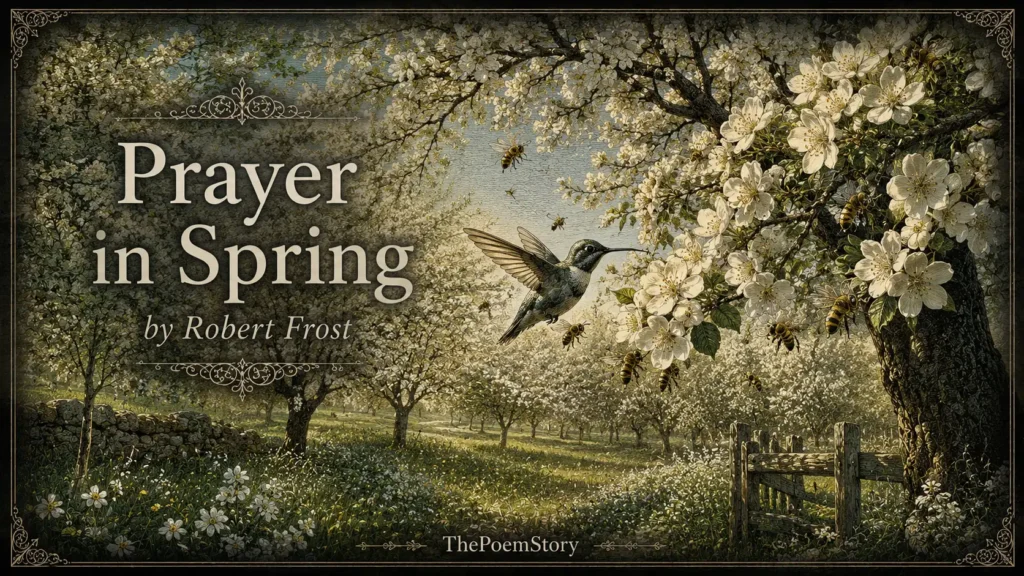
The speaker asks to be made happy in the “darting bird” that suddenly appears above the bees. The bird is like a “meteor”—fast, bright, and surprising. It “thrusts in with needle bill” and then “off a blossom in mid air stands still.” This is a vivid image of a hummingbird or similar bird, hovering in mid-air, suspended between heaven and earth, a moment of perfect stillness within movement.
The bird’s stillness in mid-air is a kind of miracle—a suspension of the ordinary laws of gravity. It is a moment of grace, of beauty, of the extraordinary within the ordinary.
Stanza 4: The Definition of Love
The final stanza delivers the poem’s profound conclusion: “For this is love and nothing else is love.” The speaker defines love as the experience of presence—the pleasure in the flowers, the happiness in the bees, the joy in the darting bird. Love is not an abstract concept; it is the act of being fully present to the beauty of the world.
The speaker acknowledges that it is “reserved for God above / To sanctify to what far ends He will.” God may have larger purposes, but it “only needs that we fulfil.” Love requires our participation, our presence, our attention. The poem ends with a gentle call to action: we must fulfill love by being present, by experiencing the world with gratitude and wonder.
This completes our Prayer in Spring poem summary, revealing a poem about presence, gratitude, and the definition of love as the act of being fully alive to the moment.
Major Themes in Prayer in Spring by Robert Frost
Now that we have a clear understanding of the narrative, let us examine the profound themes in Prayer in Spring by Robert Frost. This seemingly simple prayer contains layers of spiritual and philosophical insight.
1. Presence and Mindfulness
The central theme of the poem is presence—the ability to experience the beauty of the present moment without being distracted by anxiety about the future. The speaker asks to be kept “here / All simply in the springing of the year.” This is a prayer for mindfulness, for the capacity to be fully alive to the beauty of the world around us.
This theme resonates with modern mindfulness practices and the recognition that anxiety about the future robs us of the joy of the present.
2. The Beauty of Spring
The poem celebrates the beauty of spring—the flowers, the orchard, the bees, the darting bird. Spring is a season of renewal, growth, and life. The poem invites us to appreciate this beauty with full attention and gratitude.
3. Love as Presence
The poem defines love as the act of being present. “For this is love and nothing else is love.” Love is not a grand abstraction or a romantic ideal. It is the simple act of experiencing the world with full attention, of finding pleasure in the flowers, of being happy in the bees and the birds. Love is presence.
4. The Relationship Between the Human and the Divine
The poem is structured as a prayer, suggesting a relationship between the human and the divine. The speaker asks God for pleasure and happiness. But the poem concludes that while God may sanctify love to “far ends,” it is we who must fulfill it. The relationship is collaborative—God provides the opportunities, but we must respond.
5. The Extraordinary in the Ordinary
The poem finds the extraordinary in the ordinary. The blossoming orchard is “like nothing else.” The bird is like a “meteor.” The bee swarm “dilates.” The world is full of wonder if we pay attention. The poem invites us to see the miraculous in the everyday.
6. The Uncertain Harvest
The speaker asks not to think of the “uncertain harvest.” The harvest is the future—uncertain, unpredictable, worrying. The poem invites us to release our anxiety about the future and to trust in the present. The harvest will come or it will not. What matters is the spring.
7. Fulfillment
The poem ends with the idea of fulfillment. Love “only needs that we fulfil.” We must fulfill love by being present, by paying attention, by experiencing the world with gratitude. Fulfillment is not a passive state; it is an active choice, a deliberate act of attention and presence.
Literary Devices in Prayer in Spring
To fully appreciate the craftsmanship of this poem, we must examine the rich array of literary devices in Prayer in Spring. Frost employs these techniques with his characteristic subtlety and precision, creating a poem that is both simple and profoundly moving.
1. Apostrophe
The central device of the poem is apostrophe—a direct address to an absent or abstract entity. The speaker addresses God, asking for pleasure and happiness. This gives the poem its prayer-like quality and establishes a spiritual dimension.
2. Imagery
Frost’s imagery in this poem is vivid and evocative:
- Visual: “flowers,” “orchard white,” “like ghosts by night,” “happy bees,” “swarm dilating,” “perfect trees,” “darting bird,” “meteor,” “needle bill,” “blossom.”
- Auditory: “darting bird,” “above the bees is heard.”
- Kinetic: “springing,” “dilating,” “darting,” “thrusts,” “stands still.”
The imagery consistently emphasizes movement, growth, and the dynamic beauty of spring.
3. Simile
The poem contains a striking simile: the orchard is “like nothing else by day, like ghosts by night.” The comparison of the blossoming orchard to ghosts suggests ethereality, mystery, and a kind of haunting beauty. The orchard is both present and otherworldly.
4. Metaphor
The bird is compared to a “meteor”—a sudden, bright, surprising presence. The comparison elevates the bird to a cosmic scale, suggesting that the ordinary world is full of extraordinary wonders.
5. Symbolism
Several symbols enrich the poem’s meaning:
- Spring: Represents renewal, life, and the cyclical nature of existence.
- The Orchard: Represents beauty, fruitfulness, and the potential for growth.
- The Bees: Represent industry, community, and the joy of purposeful activity.
- The Darting Bird: Represents freedom, spontaneity, and the miraculous within the ordinary.
- The Uncertain Harvest: Represents the future—uncertain, unpredictable, and worrying.
- Love: Represents presence, attention, and the act of being fully alive.
6. Tone
The tone of the poem is reverent, grateful, and gently joyful. The speaker is not demanding; he is asking. The tone reflects a deep appreciation for the beauty of the world and a humble acknowledgment of human limits.
7. Rhyme and Meter
The poem follows a consistent AABB rhyme scheme in each quatrain. The meter is predominantly iambic pentameter, giving the poem a measured, stately rhythm that suits its prayer-like quality. The regular rhythm creates a sense of calm and meditation.
8. Repetition
The repetition of “Oh, give us” and “And make us” creates a rhythmic, incantatory quality. The repetition emphasizes the speaker’s earnest desire and gives the poem a liturgical, prayer-like structure.
The Deeper Meaning of Prayer in Spring
Beyond its surface-level prayer, the Prayer in Spring meaning reveals a profound meditation on the nature of love, presence, and the human relationship with the divine. This is where the poem transcends its historical context and speaks directly to the human condition.
The Prayer in Spring meaning centers on the recognition that love is not a grand abstraction but a simple act of presence. The speaker defines love as the experience of pleasure in the flowers, happiness in the bees, and joy in the darting bird. Love is not something we feel; it is something we do. It is the act of paying attention, of being fully present, of experiencing the world with gratitude.
The poem also speaks to the relationship between the human and the divine. The speaker prays to God, asking for the gift of presence. But the poem concludes that while God may sanctify love to “far ends,” it is we who must fulfill it. God provides the opportunities; we must respond. Love is a collaboration between the divine and the human.
The Prayer in Spring meaning also addresses the human tendency to worry about the future. The speaker asks not to think of the “uncertain harvest.” This is a prayer for release from anxiety, for the ability to trust in the present. The harvest may be uncertain, but the spring is here, now. The poem invites us to release our worry and to embrace the beauty of the moment.
Ultimately, the Prayer in Spring meaning is that love is presence, and presence is love. To be present to the world is to love it. To experience the beauty of spring is to participate in love. The poem is a gentle reminder to slow down, to pay attention, and to find joy in the simple wonders of existence.
Reflection on Human Life
“Prayer in Spring” offers a timeless mirror to the human condition, and its relevance only grows in our modern world of distraction, anxiety, and disconnection.
The Power of Presence
In our fast-paced, screen-filled world, presence is a rare and precious gift. We are constantly distracted, constantly thinking about the future, constantly worrying about what comes next. The poem invites us to slow down, to be present, to experience the beauty of the moment. This is not a luxury; it is a necessity for a meaningful life.
The Fear of the Future
The “uncertain harvest” is a powerful metaphor for the anxiety we feel about the future. We worry about our jobs, our relationships, our health, our children. The poem invites us to release this worry and to trust in the present. The harvest may be uncertain, but the spring is here. We can choose to experience the joy of the moment rather than the fear of the future.
Love as Attention
The poem defines love as presence, as attention, as the act of experiencing the world with gratitude. This is a powerful reframing of love. Love is not a feeling; it is a choice. It is the choice to pay attention, to be present, to appreciate. We can love the world by paying attention to it. We can love each other by being present to each other.
The Sacred in the Ordinary
The poem finds the sacred in the ordinary—the flowers, the bees, the birds. This is a profound spiritual insight. We do not need to look for the divine in distant places; it is here, in the springing of the year, in the blossoming of the orchard, in the darting of the bird. The world is full of wonder if we pay attention.
The Collaboration Between Human and Divine
The poem suggests a collaboration between the human and the divine. God sanctifies love, but we must fulfill it. This is a powerful vision of human agency. We are not passive recipients of grace; we are active participants. We must choose to be present, to pay attention, to love. The divine provides the opportunity; we must respond.
The Simplicity of Fulfillment
The poem ends with the idea that love “only needs that we fulfil.” Fulfillment is simple. It does not require grand gestures or heroic acts. It requires presence, attention, and gratitude. We can fulfill love by simply being here, by experiencing the world, by finding joy in the beauty of existence.
Conclusion
“Prayer in Spring” is a quiet masterpiece of early Frost—a poem that rewards careful reading and deep reflection. It is a meditation on presence, love, and the beauty of the natural world. Through its prayer-like structure, its vivid imagery, and its profound definition of love, the poem invites us to be present, to pay attention, and to find joy in the springing of the year.
Through our Prayer in Spring by Robert Frost analysis, we have explored the poem’s structure, its Prayer in Spring poem summary, the profound themes in Prayer in Spring by Robert Frost, the masterful literary devices in Prayer in Spring, and the enduring Prayer in Spring meaning.
“Prayer in Spring” reminds us that love is presence, that the ordinary is sacred, and that fulfillment is simple. It invites us to release our anxiety about the future and to embrace the beauty of the present. The poem is a gentle call to slow down, to pay attention, and to find joy in the simple wonders of existence.
If you have ever found joy in the blossoming of a tree, the buzzing of bees, or the darting of a bird, then you have experienced the love that Frost describes. And like him, you have discovered that love is not a distant ideal but a present reality—available to us all, in every moment, in the springing of the year.
Enjoyed this deep dive into Frost’s poetry? If you want to explore more of his work, consider adding a complete collection to your library. There is no better companion for a spring day than the timeless verses of Robert Frost.
Did this analysis illuminate a new perspective on “Prayer in Spring” for you? Drop a comment below and let me know your thoughts. If you found this valuable, please share it with a fellow poetry enthusiast!
Read and explore ThePoemStory and go through Collected Poems of Robert Frost.
for more poems explore Poetry Section

Get the ThePoemStory App — Read Poems Anywhere