Robert Frost stands as one of the colossal figures of 20th-century American poetry. Known for his accessible yet profoundly layered verses, Frost often employed the rural landscapes of New England as a canvas for exploring the deepest crevices of the human psyche. While his later works, such as “The Road Not Taken” and “Stopping by Woods on a Snowy Evening,” cemented his place in the public consciousness, it is in his early collections that we find the raw, unpolished seeds of his genius.
This Going for Water by Robert Frost analysis examines one of the most charming and vividly nostalgic poems from his debut collection, A Boy’s Will (1913). “Going for Water” captures a simple childhood adventure—a journey across autumn fields to a brook when the well runs dry. Yet beneath its surface of innocent play lies a profound meditation on the nature of discovery, the joy of the journey, and the moment when we first hear the voice of the world speaking to us.
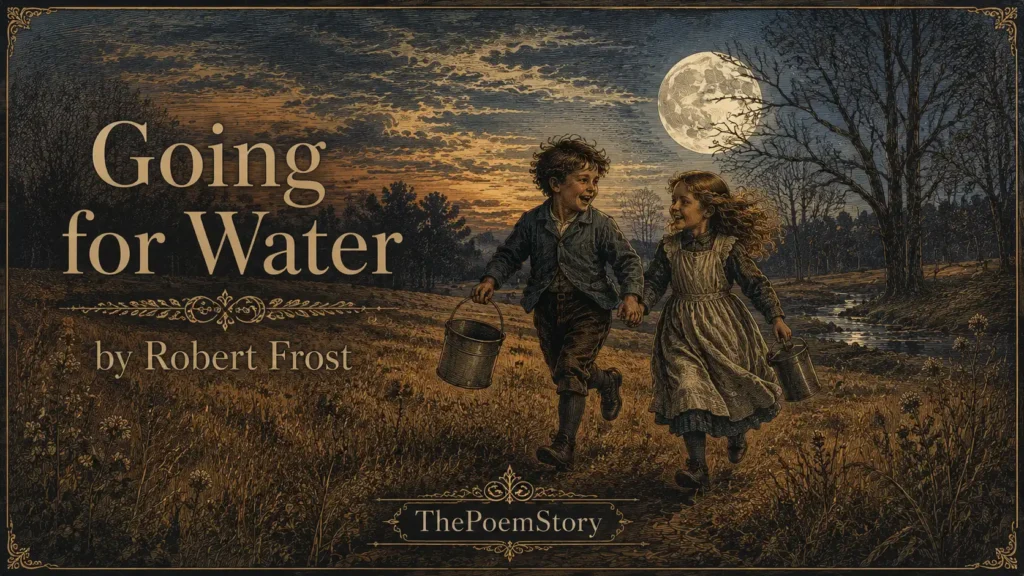
The poem presents two children (or perhaps a child and a companion) who set out with pail and can to find water. The well is dry, so they must venture to the brook. But they are “not loth to have excuse to go”—they welcome the adventure. The autumn evening is fair, the fields are theirs, and the woods by the brook are their playground. They run as if to meet the moon, pause like gnomes hiding from its light, and finally—in the hush of the wood—they hear the brook. The sound is like pearls and a silver blade, a moment of pure discovery.
In this comprehensive guide, we will dissect “Going for Water” with careful attention to its structure, language, and emotional resonance. We will provide a detailed Going for Water poem summary, explore the profound themes in Going for Water by Robert Frost, examine its masterful literary devices in Going for Water, and ultimately reflect on the Going for Water meaning and what it reveals about the human experience of discovery, wonder, and the joy of simple adventures.
If you enjoyed this analysis, you might also like our analysis of 5 short poems by Robert Frost, which explores “A Dream Pang,” “In Neglect,” “The Vantage Point,” “Mowing,” and “Revelation.”
Read and explore ThePoemStory and go through Collected Poems of Robert Frost.
for more poems explore Poetry Section
Going for Water by Robert Frost analysis
The Poem – Going for Water by Robert Frost
The well was dry beside the door,
~ Going for Water by Robert Frost – Analysis and Summary
And so we went with pail and can
Across the fields behind the house
To seek the brook if still it ran;
Not loth to have excuse to go,
Because the autumn eve was fair
(Though chill), because the fields were ours,
And by the brook our woods were there.
We ran as if to meet the moon
That slowly dawned behind the trees,
The barren boughs without the leaves,
Without the birds, without the breeze.
But once within the wood, we paused
Like gnomes that hid us from the moon,
Ready to run to hiding new
With laughter when she found us soon.
Each laid on other a staying hand
To listen ere we dared to look,
And in the hush we joined to make
We heard, we knew we heard the brook.
A note as from a single place,
A slender tinkling fall that made
Now drops that floated on the pool
Like pearls, and now a silver blade.
Going for Water Poem Summary
Before delving into the thematic and literary depths, it is essential to establish a clear Going for Water poem summary to ensure every reader grasps the narrative and emotional arc of this delightful lyric. The poem is structured in six stanzas of four lines each (quatrains), with a consistent ABAB rhyme scheme that gives it a gentle, musical quality.
Stanza 1: The Dry Well and the Journey
The poem opens with a simple, practical problem: “The well was dry beside the door.” The speaker and a companion must fetch water. They take “pail and can” and go “Across the fields behind the house / To seek the brook if still it ran.” The journey is necessary, but it is also an adventure. The question “if still it ran” suggests uncertainty—the brook might be dry too.
Stanza 2: The Joy of the Excuse
The second stanza reveals that the children are “Not loth to have excuse to go.” They welcome the errand. The autumn evening is “fair (Though chill).” The fields are theirs, and “by the brook our woods were there.” The journey is not a chore; it is an opportunity to explore, to claim their territory, to experience the beauty of the autumn evening.
Stanza 3: Running to Meet the Moon
The children run “as if to meet the moon / That slowly dawned behind the trees.” The moon is rising, and they run toward it. The trees are “barren boughs without the leaves, / Without the birds, without the breeze.” The landscape is bare, stripped of its summer life. But the children do not mind; they are full of energy and anticipation.
Stanza 4: The Gnomes and the Game
Once inside the wood, the children pause “Like gnomes that hid us from the moon.” They play a game of hiding, pretending to be gnomes who must avoid the moon’s light. They are “Ready to run to hiding new / With laughter when she found us soon.” The playfulness is pure, joyful, and innocent. The moon is personified as a playful seeker.
Stanza 5: The Hush and the Discovery
The children become quiet. “Each laid on other a staying hand / To listen ere we dared to look.” They listen carefully. “And in the hush we joined to make / We heard, we knew we heard the brook.” The discovery is both auditory and certain. They hear the brook, and they know it. The moment is one of pure awareness, of connection to the natural world.
Stanza 6: The Sound of the Brook
The final stanza describes the brook’s sound: “A note as from a single place, / A slender tinkling fall that made / Now drops that floated on the pool / Like pearls, and now a silver blade.” The sound is delicate, musical, and variable. It is like pearls floating on water, and like a silver blade—both beautiful and sharp, gentle and clear.
This completes our Going for Water poem summary, revealing a poem about the joy of childhood adventure, the wonder of discovery, and the moment when we first hear the voice of nature.
Major Themes in Going for Water by Robert Frost
Now that we have a clear understanding of the narrative, let us examine the profound themes in Going for Water by Robert Frost. This seemingly simple poem contains layers of psychological and philosophical insight.
1. The Joy of Childhood Adventure
The central theme of the poem is the joy of childhood adventure. The children are “Not loth to have excuse to go.” They welcome the errand because it allows them to explore, to run, to play. The journey is not a chore; it is a gift. The poem captures the infectious energy and wonder of childhood.
2. The Beauty of the Journey
The poem emphasizes that the journey is as important as the destination. The children do not simply go to the brook; they experience the autumn evening, the moon, the woods, and the game of hiding. The journey is full of beauty and wonder. The poem suggests that life is not just about reaching goals but about the experiences we have along the way.
3. The Wonder of Discovery
The moment when the children hear the brook is a moment of pure discovery. They pause, listen, and know. The poem captures the thrill of finding something, of connecting with the natural world. The brook’s sound is beautiful and mysterious—a “slender tinkling fall” that is both like pearls and a silver blade.
4. The Connection Between Children and Nature
The children are deeply connected to the natural world. They run to meet the moon, hide like gnomes, and listen to the brook. The natural world is not a backdrop; it is a companion. The poem celebrates the intimacy between children and nature—a connection that often fades with adulthood.
5. The Suspended Moment
The poem captures a suspended moment—the moment before the brook is seen, when it is only heard. The children pause, lay hands on each other, and listen. This moment of stillness is the heart of the poem. It is a moment of pure attention, pure presence.
6. The Contrast Between the Dry Well and the Running Brook
The well is dry—dead, empty, useless. The brook is running—alive, musical, full. The poem contrasts the dryness of the domestic space with the vitality of the natural world. The children must leave the house to find life. The poem suggests that we must venture beyond our comfortable spaces to find what we truly need.
7. The Music of Nature
The brook’s sound is described as a “note,” a “slender tinkling fall,” “pearls,” and a “silver blade.” The poem celebrates the music of nature—the sounds that are always there if we stop to listen. The children hear the brook because they pause and listen. The poem invites us to do the same.
Literary Devices in Going for Water
To fully appreciate the craftsmanship of this poem, we must examine the rich array of literary devices in Going for Water. Robert Frost employs these techniques with his characteristic subtlety and precision, creating a poem that is both simple and profoundly moving.
1. Imagery
Frost’s imagery in this poem is evocative and sensory:
- Visual: “dry well,” “pail and can,” “fields behind the house,” “autumn eve,” “moon slowly dawned behind the trees,” “barren boughs without the leaves,” “gnomes,” “pearls,” “silver blade.”
- Auditory: “note,” “slender tinkling fall,” “drops,” “hush.”
- Tactile: “chill,” “staying hand.”
- Kinetic: “ran,” “paused,” “run to hiding new,” “dared to look.”
The imagery consistently emphasizes movement, light, and sound, creating a vivid sensory experience.
2. Simile
The poem contains two striking similes:
- “Like gnomes that hid us from the moon”: The children are compared to gnomes—mythical, playful creatures who hide from the light. This simile captures the magical quality of childhood play.
- “drops that floated on the pool / Like pearls”: The drops of water are compared to pearls—precious, beautiful, and perfect. This simile elevates the brook’s sound to something valuable and rare.
3. Personification
The moon is personified as a playful seeker: “When she found us soon.” The moon is given a gender and an intention. This personification makes the natural world feel alive and interactive.
4. Symbolism
Several symbols enrich the poem’s meaning:
- The Dry Well: Represents the absence of life, creativity, or inspiration. It is empty and useless.
- The Running Brook: Represents life, vitality, creativity, and the voice of nature.
- The Pail and Can: Represent the tools of human need, the practical reason for the journey.
- The Autumn Eve: Represents the beauty of transition, the fading of the year, the melancholy of autumn.
- The Moon: Represents mystery, guidance, and the playful light of the natural world.
- The Gnomes: Represent the playful, mythical dimension of childhood imagination.
- The Pearls: Represent the preciousness of the brook’s sound, the value of discovery.
- The Silver Blade: Represents the sharpness, clarity, and beauty of the brook’s sound.
5. Tone
The tone of the poem is nostalgic, joyful, and slightly wistful. The speaker recalls a childhood memory with fondness and wonder. There is a sense of loss—the childhood is past—but also a sense of gratitude for the memory.
6. Rhyme and Meter
The poem follows a consistent ABAB rhyme scheme in each quatrain. The meter is predominantly iambic, with variations that reflect the children’s movement and energy. The regular rhythm creates a sense of calm and musicality.
7. Enjambment
Robert Frost uses enjambment to create a sense of flow and continuity. The lines run into each other, mimicking the children’s movement across the fields. The poem does not pause; it moves, just as the children move.
8. Alliteration
Frost uses alliteration to create musical effects: “pail and can,” “fields behind,” “barren boughs,” “birds, breeze,” “slender tinkling.” These repeated sounds give the poem a gentle, rhythmic quality.
The Deeper Meaning of Going for Water
Beyond its surface-level narrative, the Going for Water meaning reveals a profound meditation on the nature of discovery, the joy of the journey, and the moment when we first hear the voice of the world speaking to us. This is where the poem transcends its historical context and speaks directly to the human condition.
The Going for Water meaning centers on the recognition that the journey is as important as the destination. The children need water, but they also need the adventure. The well is dry, but the brook is running. The practical need leads to a moment of wonder. The poem suggests that necessity can be the mother of discovery.
The poem also speaks to the importance of play. The children run, hide, and laugh. They turn a chore into a game. This playfulness is not frivolous; it is essential. It allows them to see the world with fresh eyes, to hear the brook as if for the first time. The poem suggests that play is a form of attention, a way of being present to the world.
The Going for Water meaning also addresses the relationship between humans and nature. The children are connected to the natural world. They run to meet the moon, hide like gnomes, and listen to the brook. The natural world is not a threat; it is a companion. The poem celebrates the intimacy between children and nature.
Ultimately, the Going for Water meaning is that discovery requires attention. The children hear the brook because they pause and listen. They do not rush; they stop, they lay hands on each other, they enter the hush. The poem invites us to slow down, to pay attention, and to listen for the voice of the world.
Reflection on Human Life
“Going for Water” offers a timeless mirror to the human condition, and its relevance only grows in our modern world of distraction and disconnection from the natural world.
The Importance of the Journey
We often focus on destinations—on goals, achievements, and results. The poem reminds us that the journey is equally important. The children’s adventure across the fields, their run to meet the moon, their game of hiding—these are the moments that matter. The poem invites us to value the journey, to savor the experiences along the way.
The Power of Play
In our serious, productive culture, play is often seen as frivolous. The poem reminds us that play is essential. It allows us to see the world with fresh eyes, to connect with others, to discover new things. The poem invites us to embrace play, to find joy in simple adventures.
The Need for Attention
The children hear the brook because they pause and listen. In our noisy, distracted world, we rarely pause to listen. The poem invites us to slow down, to pay attention, to enter the hush. The voice of the world is always there; we just need to be quiet enough to hear it.
The Connection Between Necessity and Discovery
The children need water, and this necessity leads them to the brook. The poem suggests that necessity can be a gift—it can push us out of our comfort zones and into the world of discovery. The dry well is not a tragedy; it is an opportunity.
The Magic of Childhood
The poem captures the magic of childhood—the ability to turn a chore into an adventure, to see the world as full of wonder, to play like gnomes hiding from the moon. The poem invites us to reconnect with that magic, to see the world through the eyes of a child.
The Music of Nature
The brook’s sound is described as pearls and a silver blade. The poem celebrates the music of nature—the sounds that are always there if we stop to listen. The poem invites us to listen, to hear the beauty of the natural world.
Conclusion
“Going for Water” is a delightful masterpiece of early Robert Frost—a poem that rewards careful reading and deep reflection. It is a meditation on the joy of childhood adventure, the wonder of discovery, and the music of the natural world. Through its vivid imagery, its playful tone, and its quiet moment of discovery, the poem invites us to reconnect with the magic of the world.
Through our Going for Water by Robert Frost analysis, we have explored the poem’s structure, its Going for Water poem summary, the profound themes in Going for Water by Robert Frost, the masterful literary devices in Going for Water, and the enduring Going for Water meaning.
“Going for Water” is a reminder that the journey is as important as the destination, that play is essential, and that the voice of the world is always waiting to be heard. It invites us to pause, to listen, and to discover the beauty that surrounds us.
If you have ever gone on a simple adventure, run to meet the moon, or paused to listen to the sound of water, then you have walked with Robert Frost. And like him, you have discovered that the world is full of wonder—if only we pay attention.
Related Posts
- 5 Short Poems by Robert Frost – Analysis and Summary – Explore “A Dream Pang,” “In Neglect,” “The Vantage Point,” “Mowing,” and “Revelation.”
- In a Vale by Robert Frost – Analysis and Summary – A mystical meditation on memory, beauty, and the origins of art.
- Waiting (Afield at Dusk) by Robert Frost – Analysis and Summary – An introspective meditation on solitude, memory, and longing.
- Rose Pogonias by Robert Frost – Analysis and Summary – An exquisite meditation on sacred beauty and preservation.
Enjoyed this deep dive into Frost’s poetry? If you want to explore more of his work, consider adding a complete collection to your library. There is no better companion for a quiet evening than the timeless verses of Robert Frost.
Did this analysis illuminate a new perspective on “Going for Water” for you? Drop a comment below and let me know your thoughts. If you found this valuable, please share it with a fellow poetry enthusiast!
Read and explore ThePoemStory and go through Collected Poems of Robert Frost.
for more poems explore Poetry Section
Get the ThePoemStory App — Read Poems Anywhere