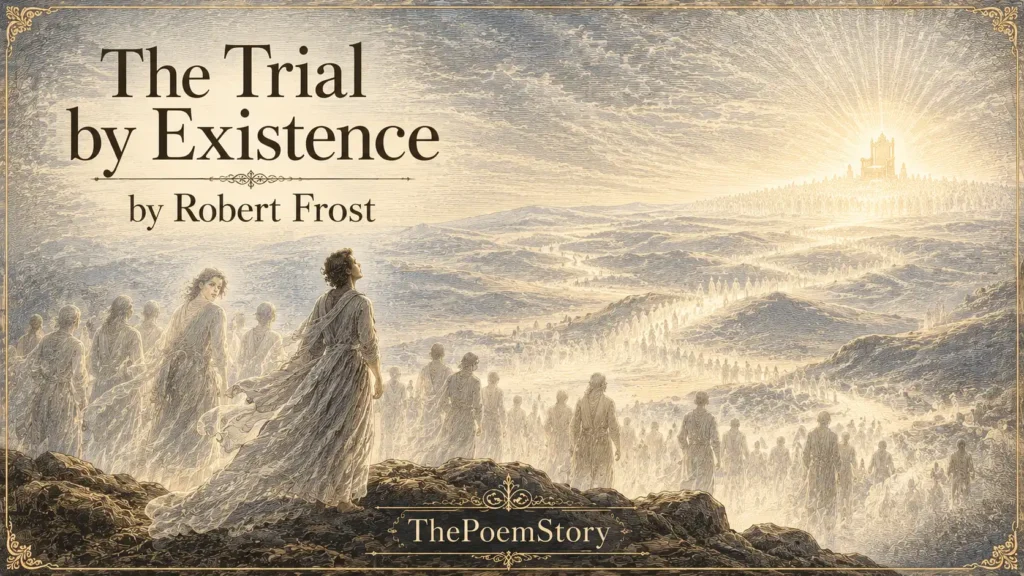
Robert Frost stands as one of the colossal figures of 20th-century American poetry. Known for his accessible yet profoundly layered verses, Frost often employed the rural landscapes of New England as a canvas for exploring the deepest crevices of the human psyche. While his later works, such as “The Road Not Taken” and “Stopping by Woods on a Snowy Evening,” cemented his place in the public consciousness, it is in his early collections that we find the raw, unpolished seeds of his genius.
This The Trial by Existence by Robert Frost analysis examines one of the most ambitious, philosophical, and spiritually charged poems from his debut collection, A Boy’s Will (1913). “The Trial by Existence” is a cosmic meditation on the nature of life, death, choice, and the soul’s journey through existence. It is unlike any other poem in the collection—a sweeping, almost mystical exploration of the soul’s descent from paradise into earthly life, the trial of existence, and the mysterious purpose of human suffering.
The poem presents a vision of the afterlife: brave souls who have died on earth wake in paradise to find that valor still reigns. They had expected eternal rest in “wide fields of asphodel,” but instead discover that the ultimate reward of daring is “still to dare.” The poem then traces the journey of souls who choose to be born into earthly existence, the trial by existence, and the agonizing choice that each soul must make. The poem concludes with the sobering realization that we cannot remember our choice, and that this forgetting is “of the essence of life here.”
In this comprehensive guide, we will dissect “The Trial by Existence” with careful attention to its structure, language, and profound philosophical resonance. We will provide a detailed The Trial by Existence poem summary, explore the profound themes in The Trial by Existence by Robert Frost, examine its masterful literary devices in The Trial by Existence, and ultimately reflect on the The Trial by Existence meaning and what it reveals about the human condition, the nature of choice, and the mystery of existence.
If you enjoyed this analysis, you might also like our analysis of Going for Water by Robert Frost, a charming poem about childhood adventure and discovery.
Read and explore ThePoemStory and go through Collected Poems of Robert Frost.
for more poems explore Poetry Section
The Trial by Existence by Robert Frost Analysis
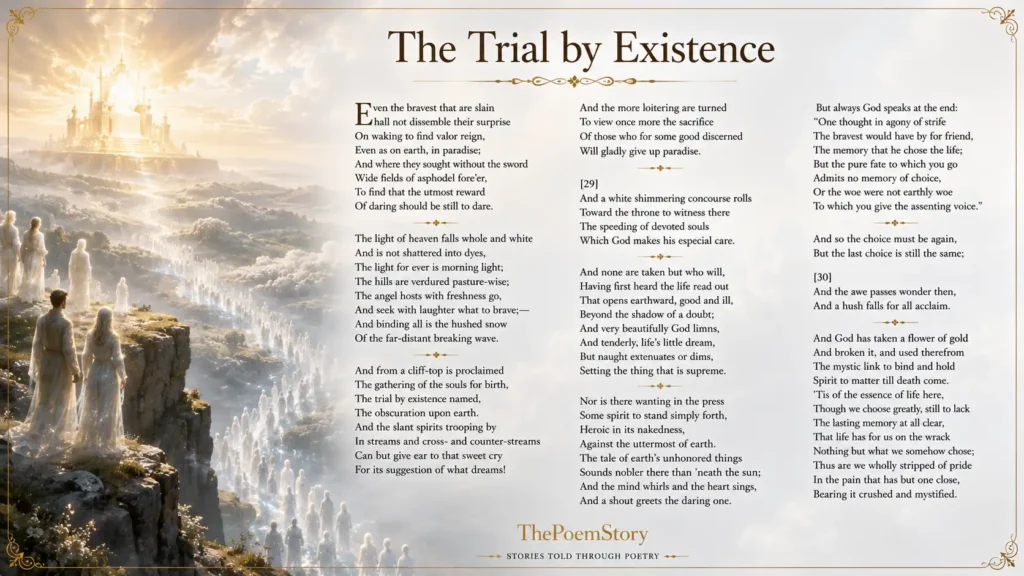
The Poem – The Trial by Existence by Robert Frost
Even the bravest that are slain
~ The Trial by Existence by Robert Frost – Analysis and Summary
Shall not dissemble their surprise
On waking to find valor reign,
Even as on earth, in paradise;
And where they sought without the sword
Wide fields of asphodel fore’er,
To find that the utmost reward
Of daring should be still to dare.
The light of heaven falls whole and white
And is not shattered into dyes,
The light for ever is morning light;
The hills are verdured pasture-wise;
The angel hosts with freshness go,
And seek with laughter what to brave;—
And binding all is the hushed snow
Of the far-distant breaking wave.
And from a cliff-top is proclaimed
The gathering of the souls for birth,
The trial by existence named,
The obscuration upon earth.
And the slant spirits trooping by
In streams and cross- and counter-streams
Can but give ear to that sweet cry
For its suggestion of what dreams!
And the more loitering are turned
To view once more the sacrifice
Of those who for some good discerned
Will gladly give up paradise.
And a white shimmering concourse rolls
Toward the throne to witness there
The speeding of devoted souls
Which God makes his especial care.
And none are taken but who will,
Having first heard the life read out
That opens earthward, good and ill,
Beyond the shadow of a doubt;
And very beautifully God limns,
And tenderly, life’s little dream,
But naught extenuates or dims,
Setting the thing that is supreme.
Nor is there wanting in the press
Some spirit to stand simply forth,
Heroic in its nakedness,
Against the uttermost of earth.
The tale of earth’s unhonored things
Sounds nobler there than ‘neath the sun;
And the mind whirls and the heart sings,
And a shout greets the daring one.
But always God speaks at the end:
‘One thought in agony of strife
The bravest would have by for friend,
The memory that he chose the life;
But the pure fate to which you go
Admits no memory of choice,
Or the woe were not earthly woe
To which you give the assenting voice.’
And so the choice must be again,
But the last choice is still the same;
And the awe passes wonder then,
And a hush falls for all acclaim.
And God has taken a flower of gold
And broken it, and used therefrom
The mystic link to bind and hold
Spirit to matter till death come.
‘Tis of the essence of life here,
Though we choose greatly, still to lack
The lasting memory at all clear,
That life has for us on the wrack
Nothing but what we somehow chose;
Thus are we wholly stripped of pride
In the pain that has but one close,
Bearing it crushed and mystified.
The Trial by Existence Poem Summary
Before delving into the thematic and literary depths, it is essential to establish a clear The Trial by Existence poem summary to ensure every reader grasps the narrative and philosophical arc of this ambitious cosmic meditation. The poem is structured in eleven stanzas of varying lengths, with a consistent ABAB rhyme scheme that gives it a stately, almost hymn-like quality. It is a narrative of the soul’s journey from paradise to earth and back again.
Stanzas 1–2: The Surprise of Paradise
The poem opens with a striking image: the bravest souls who have been slain on earth wake in paradise to find “valor reign, / Even as on earth, in paradise.” They are surprised. They had expected rest in “wide fields of asphodel,” but instead find that the “utmost reward / Of daring should be still to dare.”
The second stanza describes heaven: the light is “whole and white,” not broken into colors. It is “for ever morning light.” The hills are green “pasture-wise.” Angel hosts go with “freshness” and “seek with laughter what to brave.” Binding all is the “hushed snow / Of the far-distant breaking wave.” This is a heaven of eternal freshness, eternal dawn, and eternal challenge.
Stanzas 3–4: The Call to Birth
From a cliff-top, a proclamation is made: the “gathering of the souls for birth,” the “trial by existence named,” the “obscuration upon earth.” Souls are being called to be born. The “slant spirits” troop by “in streams and cross- and counter-streams.” They hear the “sweet cry” of the call and are drawn to it. Some loiter, turning back to view “the sacrifice / Of those who for some good discerned / Will gladly give up paradise.”
Stanzas 5–7: The Selection and the Life
A “white shimmering concourse” rolls toward the throne to witness the “speeding of devoted souls / Which God makes his especial care.” None are taken “but who will”—each soul must choose. They hear the “life read out / That opens earthward, good and ill.” God “beautifully limns, / And tenderly, life’s little dream.”
Some souls stand forth “Heroic in its nakedness, / Against the uttermost of earth.” The “tale of earth’s unhonored things / Sounds nobler there than ‘neath the sun.” A shout greets the daring one.
Stanzas 8–10: The Choice and the Forgetting
God speaks at the end. The bravest would want one thought as a friend in the “agony of strife”: the memory that he chose the life. But “the pure fate to which you go / Admits no memory of choice, / Or the woe were not earthly woe.” The soul must choose again, but “the last choice is still the same.” Awe passes wonder, and a hush falls.
God takes a “flower of gold” and breaks it, using the “mystic link to bind and hold / Spirit to matter till death come.” This is the bond of life.
Stanza 11: The Essence of Life
The final stanza delivers the poem’s sobering conclusion: “Though we choose greatly, still to lack / The lasting memory at all clear.” We cannot remember our choice. We are “wholly stripped of pride / In the pain that has but one close, / Bearing it crushed and mystified.”
This completes our The Trial by Existence poem summary, revealing a poem about the mystery of existence, the nature of choice, and the human condition of forgetting.
Major Themes in The Trial by Existence by Robert Frost
Now that we have a clear understanding of the narrative, let us examine the profound themes in The Trial by Existence by Robert Frost. This ambitious poem contains layers of theological and philosophical insight.
1. The Trial of Existence
The central theme of the poem is existence itself as a trial—a test, a challenge, an obscuration. Life on earth is the “trial by existence named, / The obscuration upon earth.” The soul descends from the clarity of paradise into the confusion of earthly life. Existence is not a punishment but a test, an opportunity for daring and choice.
2. The Reward of Daring
The poem challenges the conventional idea of heavenly reward. The “utmost reward / Of daring should be still to dare.” The brave do not find rest in paradise; they find more challenge, more daring, more growth. The reward of courage is not peace but the opportunity for more courage.
3. The Mystery of Choice
The poem explores the nature of choice. Souls choose to be born, but they cannot remember their choice. This forgetting is “of the essence of life here.” We make choices, but we cannot remember making them. We are “stripped of pride” and left “crushed and mystified.”
4. The Sacrifice of Paradise
The souls who choose to be born “gladly give up paradise.” They sacrifice eternal bliss for earthly existence. This sacrifice is an act of daring, a willing embrace of suffering for some “good discerned.” The poem suggests that life on earth is a willing sacrifice, a choice made for a higher purpose.
5. The Nature of God
The poem presents a complex vision of God. God “limns” life “beautifully” and “tenderly,” but “naught extenuates or dims, / Setting the thing that is supreme.” God is both tender and absolute, both loving and demanding. God uses a “flower of gold” to bind spirit to matter. The divine is both beautiful and mysterious.
6. Heroism and Nakedness
The poem celebrates the hero who stands “forth, / Heroic in its nakedness, / Against the uttermost of earth.” True heroism is vulnerability—the willingness to be exposed, to risk, to dare without armor. This heroism is honored in heaven: “a shout greets the daring one.”
7. The Mystic Link
God uses a “flower of gold” to create the “mystic link” that “bind and hold / Spirit to matter till death come.” This is the bond of life itself—the mysterious connection between soul and body, spirit and matter. The poem suggests that this bond is both beautiful and painful.
8. The Pain of Forgetting
The final theme is the pain of forgetting. We cannot remember our choice. We are “stripped of pride” and left “crushed and mystified.” The poem suggests that this forgetting is essential to earthly existence—without it, life would not be a true trial.
Literary Devices in The Trial by Existence
To fully appreciate the craftsmanship of this poem, we must examine the rich array of literary devices in The Trial by Existence. Robert Frost employs these techniques with his characteristic precision and ambition, creating a poem that is both philosophically profound and poetically beautiful.
1. Imagery
Frost’s imagery in this poem is vast and celestial:
- Visual: “wide fields of asphodel,” “light of heaven falls whole and white,” “hills are verdured pasture-wise,” “hushed snow,” “far-distant breaking wave,” “white shimmering concourse,” “flower of gold.”
- Auditory: “sweet cry,” “shout greets the daring one.”
- Kinetic: “trooping by,” “streams and cross- and counter-streams,” “concourse rolls.”
The imagery consistently emphasizes whiteness, light, and vastness—a vision of heaven that is both beautiful and overwhelming.
2. Symbolism
Several symbols enrich the poem’s meaning:
- Asphodel: In Greek mythology, the flower of the underworld, associated with rest and forgetfulness. The souls expected this but found instead more daring.
- The Light of Heaven: Represents divine truth, whole and undivided.
- The Hushed Snow: Represents peace, stillness, and the boundary of heaven.
- The Cliff-Top: Represents the threshold between heaven and earth.
- The Flower of Gold: Represents the divine spark, the bond between spirit and matter.
- The Mystic Link: Represents the connection between soul and body, the mystery of incarnation.
3. Metaphor
The poem contains powerful metaphors:
- Life on earth is a “trial” and an “obscuration.”
- God “limns” life—paints it like an artist.
- Death is “one close”—a single conclusion.
4. Personification
The poem personifies abstract concepts. Valor “reigns.” The “light of heaven” is described as whole and white. The “hushed snow” binds all. God “limns” and “speaks.” The “mind whirls” and the “heart sings.” These personifications bring abstract concepts to life.
5. Paradox
The poem is built on paradoxes:
- “The utmost reward / Of daring should be still to dare.”
- Souls gladly give up paradise.
- We choose greatly but cannot remember our choice.
6. Tone
The tone of the poem is solemn, reverent, and slightly melancholic. The speaker approaches the cosmic themes with awe and humility. There is a sense of mystery, of things beyond human understanding.
7. Rhyme and Meter
The poem follows a consistent ABAB rhyme scheme throughout. The meter is predominantly iambic tetrameter, giving the poem a stately, hymn-like rhythm. The regular rhythm creates a sense of cosmic order and solemnity.
8. Alliteration
Robert Frost uses alliteration to create musical effects: “wide fields,” “whole and white,” “hushed snow,” “slant spirits,” “streams and cross- and counter-streams,” “white shimmering,” “mystic link,” “spirit to matter.” These repeated sounds give the poem a rhythmic, incantatory quality.
The Deeper Meaning of The Trial by Existence
Beyond its surface-level narrative, the The Trial by Existence meaning reveals a profound meditation on the nature of life, choice, and the human condition. This is where the poem transcends its historical context and speaks directly to the human condition.
The The Trial by Existence meaning centers on the recognition that life is a trial—a test of courage, a test of choice. We are born into a state of obscuration, cut off from the memory of our choice, forced to live without certainty. The poem suggests that this uncertainty is essential to the trial. If we knew why we were here, if we remembered our choice, existence would not be a true test.
The poem also speaks to the nature of heroism. The brave souls who choose to be born are heroes not because they succeed but because they dare. The “utmost reward of daring should be still to dare.” Heroism is not a destination but a way of being—a willingness to risk, to choose, to stand “naked” against the world.
The The Trial by Existence meaning also addresses the mystery of suffering. We are “crushed and mystified” by our pain. We cannot remember why we chose this life. But the poem suggests that this forgetting is a gift—without it, our suffering would be unbearable. We are given the strength to bear our pain because we cannot remember that we chose it.
Ultimately, the The Trial by Existence meaning is that life is a mystery, but it is a mystery we have chosen. We are not passive victims of fate; we are active participants in our own existence. The poem invites us to embrace our choices, to dare greatly, and to accept the mystery of our own existence.
Reflection on Human Life
“The Trial by Existence” offers a timeless mirror to the human condition, and its relevance only grows in our modern world of existential uncertainty and spiritual searching.
The Mystery of Existence
The poem reminds us that existence is a mystery. We do not know why we are here, what we are supposed to do, or where we are going. This uncertainty is not a flaw but a feature of existence. The poem invites us to embrace the mystery, to live without certainty, and to find meaning in the act of choosing.
The Courage of Choice
The poem celebrates the courage of choice. Every soul chooses to be born. Every life is a choice. The poem invites us to recognize that we are not victims of fate but participants in our own existence. We have chosen this life, and we can choose how to live it.
The Value of Suffering
The poem suggests that suffering has meaning. The souls choose to give up paradise for “some good discerned.” Suffering is not meaningless; it is part of the trial. The poem invites us to find meaning in our suffering, to see it as part of a larger purpose.
The Necessity of Forgetting
The poem suggests that forgetting is necessary. If we remembered our choice, life would not be a true trial. The forgetting allows us to live authentically, to make choices freely, to be “stripped of pride.” The poem invites us to accept our limited knowledge and to live with humility.
The Heroism of Vulnerability
The poem celebrates the hero who stands “naked” against the world. True heroism is not invulnerability but vulnerability—the willingness to be exposed, to risk, to dare. The poem invites us to embrace our vulnerability, to stand “forth” without armor.
The Mystic Bond
The poem describes the bond between spirit and matter as a “mystic link.” This bond is both beautiful and painful. The poem invites us to accept our embodiment, to honor the connection between soul and body, and to see life as a sacred union.
Conclusion
“The Trial by Existence” is an ambitious masterpiece of early Robert Frost—a poem that rewards careful reading and deep reflection. It is a cosmic meditation on the nature of life, death, choice, and the soul’s journey. Through its stately rhythm, its vivid imagery, and its profound philosophical insights, the poem invites us to contemplate the mystery of our own existence.
Through our The Trial by Existence by Robert Frost analysis, we have explored the poem’s structure, its The Trial by Existence poem summary, the profound themes in The Trial by Existence by Robert Frost, the masterful literary devices in The Trial by Existence, and the enduring The Trial by Existence meaning.
“The Trial by Existence” reminds us that life is a mystery, but it is a mystery we have chosen. It invites us to dare greatly, to embrace our vulnerability, and to accept the pain of forgetting. The poem is a call to live with courage, to choose with intention, and to trust the mystery of existence.
If you have ever wondered why you are here, what you are meant to do, or why life is so hard, then you have walked with Robert Frost. And like him, you have discovered that the trial of existence is a gift—a gift of choice, of daring, of being alive.
Related Posts
- Going for Water by Robert Frost – Analysis and Summary – A charming poem about childhood adventure and the joy of discovery.
- 5 Short Poems by Robert Frost – Analysis and Summary – Explore “A Dream Pang,” “In Neglect,” “The Vantage Point,” “Mowing,” and “Revelation.”
- In a Vale by Robert Frost – Analysis and Summary – A mystical meditation on memory, beauty, and the origins of art.
- Waiting (Afield at Dusk) by Robert Frost – Analysis and Summary – An introspective meditation on solitude, memory, and longing.
Enjoyed this deep dive into Frost’s poetry? If you want to explore more of his work, consider adding a complete collection to your library. There is no better companion for a quiet evening than the timeless verses of Robert Frost.
Did this analysis illuminate a new perspective on “The Trial by Existence” for you? Drop a comment below and let me know your thoughts. If you found this valuable, please share it with a fellow poetry enthusiast!
Read and explore ThePoemStory and go through Collected Poems of Robert Frost.
for more poems explore Poetry Section
Get the ThePoemStory App — Read Poems Anywhere